



Health financing policy and implementation in fragile and conflict-affected settings
Synthesis of evidence and policy recommendations
Overview
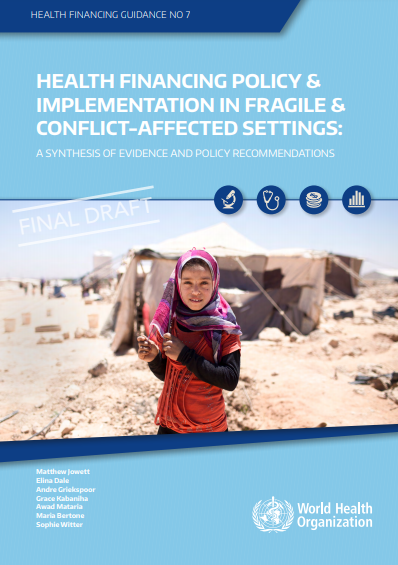
The paper aims to inform policy, i.e. the decisions and actions of those engaged in financing and delivering health services in fragile and conflict affected settings (FCAS), and its scope is limited to this agenda. It takes the perspective of public policy given its central importance for the long-term development of health systems, and as such is closely linked to the humanitarian development nexus agenda, which tries to ensure better connectivity between humanitarian and development efforts as highlighted during the World Humanitarian Summit.
It is written for those responsible for, or those who advise on, the development and improvement of health financing policies in FCAS. The intention is to not to prescribe a process or particular health financing arrangement, but to guide countries affected by fragility and conflict in developing their own health financing policies, that build from the experience and lessons from other FCAS, but are tailored to their specific context and use a comprehensive system-based approach.
This paper is the product of both a comprehensive review of both published and unpublished literature, and an extensive process of consultations.
Section 1 provides broader context, Section 2 summarizes WHO’s general policy messages on health financing, and Section 3 looks more closely at definitions of fragility and overall health system challenges in FCAS. Section 4 describes the current situation in FCAS in terms of the health financing functions and draws heavily on a detailed literature review of the evidence and secondary data analysis commissioned from the ReBUILD Consortium,
published separately as a WHO Health Financing Working Paper. Section 5 builds on Section 4 and develops specific recommendations for health financing policy development and implementation in FCAS.