
HIV-related needs in internally displaced persons and other conflict-affected populations
This assessment tool for HIV and internally displaced persons (IDPs) is an outcome of multisectoral, multi-agency assessment missions in Côte d’Ivoire, the Democratic Republic of Congo, Nepal and the United Nations High Commissioner for Refugees (UNHCR) first global consultation on HIV and internally displaced persons held in April 2007 in Geneva.
10 facts on rabies
Rabies causes thousands of deaths every year in over 100 countries mostly affecting underserved communities with limited access to health and veterinary systems. Successful rabies control programmes comprise of three pillars: community participation; education, public awareness and access to mass vaccination of dogs; and access to post bite treatment.
Countries are responding to achieve the target of zero human deaths by 2030 by scaling up their response to consign rabies to the history books.
2015 Global Survey on Health Technology Assessment by National Authorities
As countries strive to deliver universal health coverage, the process of deciding which health technologies and interventions to invest in has become increasingly important. Countries face complex choices in deciding how to direct their finite health budgets to meet the priority health needs of their populations, and in selecting from the vast array of technologies and interventions on offer. Reaching a fair and efficient outcome requires a multidisciplinary process to evaluate the social, economic, organizational and ethical aspects of a health intervention or health technology. Health Technology Assessment (HTA) is a systematic approach to evaluate the properties, effects, and impacts of health technologies or interventions. It can be applied to medical devices, medicines, vaccines, procedures, health services, and public health interventions.
This report summarises the methods and main findings of the WHO 2015 Global Survey on HTA. This survey was aimed at HTA conducted by government or national institutes. It was undertaken in response to World Health Assembly Resolution 67.23. This resolution, ‘Health intervention and technology assessment in support of universal health coverage’ called on the WHO Secretariat to assess the status of HTA globally.
Publication details
Publication details
2016: the beginning of the end of rabies?
Sept 28 is the tenth annual World Rabies Day. It is a date that commemorates the anniversary of the 1895 death of Louis Pasteur, who developed the first human rabies vaccine.
Modern effective vaccines, combined with other interventions, the necessary political will, and community awareness make the disease 100% preventable. Yet, an estimated 59 000 people still die from the disease every year. World Rabies Day is thus an uncomfortable reminder for the global health community of the ongoing neglect of this disease. The theme for 2016 is “Educate. Vaccinate. Eliminate”, a slogan that emphasises the pillars of rabies prevention and the vision to end human rabies deaths.
Publication details
Publication details
2030 targets for soil-transmitted helminthiases control programmes
The “NTD Roadmap”, published by the World Health Organization (WHO) in 2012,set two targets for the control of soil-transmitted helminthiases (STH) by 2020, namely:
- 75% of preschool (pre-SAC) and school-age children (SAC) in need of treatment are regularly treated; and
- 75% coverage with preventive chemotherapy (PC) is achieved in pre-SAC and SAC in 100% of countries.
These process indicators were selected at a time when STH control programmes were few and global coverage was estimated to be only around 15%. In addition, the cost–effectiveness of school-based deworming programmes was beginning to be fully appreciated. Expansion of programme coverage was therefore identified as an immediate priority.
Although women of reproductive age (WRA) have always been considered an important risk group for STH, no 2020 coverage targets for WRA were proposed because the Roadmap included only targets that were regarded as being achievable. WRA, with four specific subgroups of adolescent girls, pregnant and lactating women and other adult women, were considered to be much more difficult to reach.
Between 2010 and 2017, coverage of PC in pre-SAC and SAC has steadily increased. Data collected from the 103 countries endemic for STH in 2017 show that the two Roadmap targets are well within reach by 2020.
In parallel with the increase in PC coverage, there have been additional important achievements. It is estimated that, in 2015, STH control programmes averted the loss of more than 500 000 disability-adjusted life years (DALYs) in pre-SAC and SAC, out of the total of 1 300 000 DALYs that would have been lost without such programmes. Several countries have already completely eliminated STH morbidity (that is, morbidity caused almost exclusively by STH infections of moderate and heavy intensity). Furthermore, a number of countries have conducted PC programmes for more than 5 years and are evaluating their epidemiological impact in terms of morbidity.
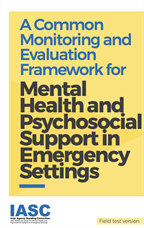
A common monitoring and evaluation framework for mental health and psychosocial support in emergency settings
This document provides guidance in the assessment, research, design, implementation and monitoring and evaluation of mental health and psychosocial support (MHPSS) programmes in emergency settings. Although designed specifically for emergency contexts (including protracted crises), the framework may also be applicable for the transition phases from emergency to development (including disaster risk reduction initiatives). The framework assumes familiarity with the Inter-Agency Standing Committee (IASC) Guidelines on Mental Health and Psychosocial Support in Emergency Settings1 and an understanding of programming in humanitarian relief and/or development.
A field guide: detection, management and surveillance of arsenicosis in South-East Asia Region
Drinking water contaminated with an unsafe level of arsenic is known to result in adverse health outcomes. In many parts of the world, the source of drinking water is groundwater. While groundwater is relatively safe as regards bacterial contamination and other impurities, it is prone to chemical contamination such as arsenic. Arsenic contamination of groundwater may occur in two ways: drawing of water from aquifers that naturally contain arsenic or contamination from anthropogenic activities such as mining. Groundwater contamination in excess of the World Health Organization guideline value of 0.01 mg/L has been observed in parts of USA, Canada, Argentina, Chile, Mexico, Hungary and many countries of the South-East Asia Region. The most affected countries in the SouthEast Asia Region are in the river basins of the GangaBrahmaputra or the Mekong Delta. Affected countries include India, Bangladesh, Nepal, Myanmar, Vietnam, Cambodia, Laos and China.
Until now there have been no internationally accepted criteria for the diagnosis and management of arsenicosis or diseases associated with arsenic exposure. The purpose of this document is to serve as a guideline for the diagnosis, surveillance and management of arsenicosis. It is recognized that arsenicosis may manifest with or without skin manifestation. However, generally skin manifestation is the primary condition leading a patient to seek medical care. Therefore, the emphasis in this document is the diagnosis of arsenicosis based on dermal manifestations.
A framework for malaria elimination
The malaria landscape has changed significantly in the last decade: funding has increased, coverage of life-saving tools has been scaled up, burden has decreased and more countries are pursuing elimination. This framework is fully aligned with the Global technical strategy for malaria 2016–2030 and addresses updates to policy and practice.
The document provides guidance on the tools, activities and strategies required to achieve malaria elimination and prevent re-establishment of transmission in countries, regardless of where they lie across the spectrum of transmission intensity. It is intended to inform national malaria elimination strategic plans and should be adapted to local contexts.
A global brief on hypertension : silent killer, global public health crisis: World Health Day 2013
The Global brief on hypertension, published on the occasion of World Health Day 2013, describes why, in the early 21st century, hypertension is a global public health issue. It describes how hypertension contributes to the burden of heart disease, stroke and kidney failure and premature death and disability. The document also explains how hypertension is both preventable and treatable and how governments, health workers, civil society, the private sector, families and individuals can join forces to reduce hypertension and its impact.
A global overview of national regulations and standards for drinking-water quality
When setting national drinking-water quality regulations and standards, many countries consider the WHO Guidelines for drinking-water quality (GDWQ). To better understand the extent to which the GDWQ are used and reflected in these standards, this global review summarizes information from 104 countries and territories on values specified in national drinking-water quality standards for aesthetic, chemical, microbiological and radiological parameters.
The information provided will support regulatory agencies and other key stakeholders to access and compare data when setting or revising national drinking-water quality regulations and standards.
A global response to elder abuse and neglect : building primary health care capacity to deal with the problem world-wide : main report
A global strategy to eliminate yellow fever epidemics (EYE) 2017–2026
In 2016 Angola was hit by an unprecedented yellow fever urban outbreak which spread to neighbouring countries and generated local transmission, including in the Democratic Republic of the Congo’s capital Kinshasa. The epidemic created an urgent need for more than 28 million doses of yellow fever vaccines total, which exhausted the existing global vaccine supply. It also diverted public health authorities from tackling other public health issues – with an impact on health systems.
In response to the Angola outbreak, the comprehensive global strategy to Eliminate Yellow fever Epidemics (EYE) was developed by WHO and partners in a matter of a few months given the on-going urgency and the looming risk of spillover to Asia, as 11 cases were exported to China.
Part of the complexity of the global issue of yellow fever epidemics is the multifactorial and evolving nature of risk and its inherent unknowns. The risk of large yellow fever epidemics and exportation to Asia or other areas with potential for yellow fever transmission – such as Zika- or dengue-prone areas – remains daunting. Yellow fever outbreaks could easily turn into public health emergencies of international concern (PHEICs) and must be prevented to not only minimize mortality, morbidity, and disruption of health systems, but also to preserve economies and social development.
A guide for conducting an Expanded Programme on Immunization(EPI) Review
An EPI Review, also referred to as National
Immunization Programme Review, is the comprehensive assessment of the strengths and weaknesses of
an immunization programme at national, subnational
and service-delivery levels. The purpose of the Review
is to provide evidence for the programme’s strategic directions
and priority activities. With this in mind, an EPI Review should be
conducted before the immunization programme’s strategic
planning cycle, such as the cMYP. Review findings are presented
formally to the Ministry of Health (MoH), other relevant ministries,
and often the country’s interagency coordinating committee (ICC)
for their responses and endorsement for incorporation into the
next strategic plan.
There are many ways an EPI Review can be conducted. The
purpose of these guidelines is to establish a benchmark against
which deviations from the standard can be made explicit. For
example, EPI Reviews include external technical experts to provide
greater technical depth, promote impartiality and increase the
visibility and credibility of the findings. If EPI Review teams are
not led by external experts, this should be made clear in the
Review reporting process. A second example follows from the
fact that EPI Reviews are increasingly being integrated with other
assessments; adapting the Review to meet other objectives is
encouraged and would also be an element to highlight as a
deviation from a standard Review.
A guide for oral disease patients to quit tobacco use
This self-help material was developed based on WHO Capacity Building Training Package 4 entitled “Strengthening health systems for treating tobacco dependence in primary care”, the latest evidence on the association between tobacco use and oral diseases as well as the evidence on the benefits of tobacco cessation on oral health outcomes. Its target audience are oral disease patients who use tobacco. The content of this self-help material includes:
- How to get ready to quit (for oral disease patients not ready to quit);
- How to plan and make quit attempts (for oral disease patients ready to quit);
- Local tobacco cessation support resources.
A guide for oral diseases patients to quit tobacco use
This self-help material was developed based on WHO Capacity Building Training Package 4 entitled “Strengthening health systems for treating tobacco dependence in primary care”, the latest evidence on the association between tobacco use and oral diseases as well as the evidence on the benefits of tobacco cessation on oral health outcomes. Its target audience are oral disease patients who use tobacco. The content of this self-help material includes:
- How to get ready to quit (for oral disease patients not ready to quit);
- How to plan and make quit attempts (for oral disease patients ready to quit);
- Local tobacco cessation support resources.
A guide to equitable water safety planning
The lack of access to safe drinking-water is felt disproportionately by those who are disadvantaged socially, economically, demographically or geographically, and explicit consideration of these groups is required to understand and address disparities.
This document describes how, with relatively modest efforts, the water safety plan (WSP) approach can bring tangible improvements in water quality and availability for all users. By providing step-by-step guidance for all WSP stakeholders, as well as good practice examples from a broad range of countries and contexts, this document serves as a practical tool to help achieve safe water for all.
The electronic version of the PowerPoint slides presented in Tool F of the document, available under “Downloads” above, is intended to facilitate the integration of equity considerations into standard WSP training events.
A guide to establishing a national haemovigilance system
The goal of haemovigilance is continuous quality improvement of the transfusion chain through corrective and preventive actions to improve donor and patient safety, improve transfusion appropriateness, and reduce wastage. At its core, a haemovigilance system resembles any continuous quality improvement cycle and shows the same elements and activities. As such, haemovigilance should be embedded into every step of the transfusion chain, and into every organization that has responsibility for a part of that chain.
A Guide to Identifying and Documenting Best Practices in Family Planning Programmes
“Best practices” are exemplary public health practices that have achieved results, and which need to be scaled up so as to benefit more people. The expansion and institutionalization of successfully tested best practices requires strategic planning. There are several creative and constructive actions by people and organizations in the health sector to improve the health outcomes of people. Disseminating knowledge of such actions widely may prevent the repetition of mistakes and loss of valuable time. Thus, the main rationale for documenting and sharing “best practices” is to enable persons and organizations working in the health sector to avoid reinventing the wheel; to improve performance and avoid the mistakes of others.
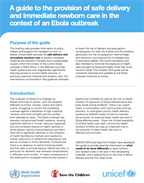
A guide to the provision of safe delivery and immediate newborn care in the context of an Ebola outbreak
This briefing note provides information to policy-makers and programme managers on how to deliver critical health services for safe delivery and immediate newborn care to prevent increased maternal and newborn mortality due to preventable causes within the context of the current Ebola outbreak in West Africa. The interventions summarized in this guide are intended to lower the risk of delivery and postpartum complications for both the mother and the newborn, particularly the risk of postpartum haemorrhage and infections, and improve the immediate care of premature babies. The recommendations are intended to minimize the exposure of health care providers to blood and bodily fluids that could transmit Ebola.
A handbook on how to implement mTB-Tobacco
The Be He@lthy, Be Mobile initiative is a
global partnership led by the World Health
Organization (WHO) and the International
Telecommunication Union (ITU), representing
the United Nations agencies for health and
information agencies for health and information
and communications technologies (ICTs). The
initiative was established in direct response to
the United Nations General Assembly’s call for
concerted action towards noncommunicable
diseases (NCDs) in 2011. The initiative supports
the scale up of mobile health (mHealth)
technology within national health systems to
help combat NCDs. These include diabetes,
cancer, cardiovascular diseases and chronic
respiratory diseases. As part of the Be He@lthy,
Be Mobile initiative, the mHealth handbooks
provide evidence-based and operational
guidance to assist countries and governments
to implement population-scale mHealth
programmes for NCDs.