

About the General Meeting
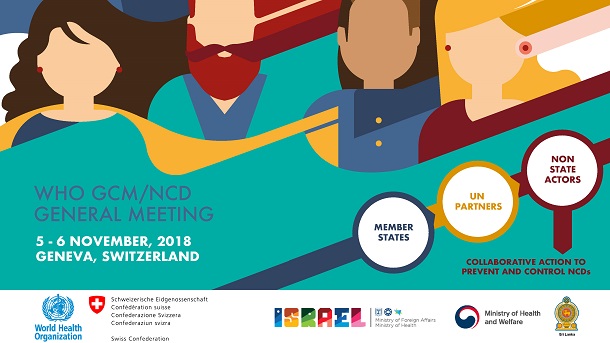
The General Meeting of the Global Coordination Mechanism on the Prevention and Control of Noncommunicable Diseases (GCM/NCD) will provide an opportunity for the GCM/NCD Participants, including all Member States, UN Agencies, funds, programmes and organizations, as well as non-State actors (NGOs, academic institutions, philanthropic foundations and business associations) “to meet face-to-face to facilitate and enhance coordination of activities, multistakeholder engagement and action across sectors at all levels to promote implementation of the WHO Global NCD Action Plan 2013-2020 and meet the NCD (SDG 3,4) and the NCD-related targets of the 2030 Agenda for Sustainable Development.
In addition, the General Meeting will discuss the results of the preliminary evaluation of the GCM/NCD in order to assess the progress made by the GCM/NCD and outline future strategic directions to enhance the GMC/NCD’s added value and continued relevance. The General Meeting will also build on the outcomes of the UN General Assembly Third High-level Meeting on the Prevention and Control of NCDs (UNGA HLM3) and provide different stakeholder perspectives on how to facilitate the implementation of the high-level commitments and the WHO Thirteenth Global Programme of Work (GPW13).
The General Meeting is mandated by the GCM/NCD terms of reference (Appendix 1, Annex3, A67/14 Add.1 8 May 2014). It will be co-organized by the Government of Switzerland and the World Health Organization (WHO).
- Global Coordination Mechanism on Noncommunicable Diseases (GCM/NCD)
- Report of the preliminary evaluation of the GCM/NCD
Objectives
- To highlight action and progress made in mobilizing multisectoral and multistakeholder partnerships to share knowledge, expertise, technology and financial resources to complement the efforts of national Governments towards achieving the nine voluntary global targets of the WHO Global Action Plan on NCDs (2013-2020) and the NCD- (SDG 3.4) and NCD-related targets of the 2030 Agenda;
- To promote and take stock of commitments and pledges made by non-State actors to support national efforts for NCD prevention and control;
- To showcase and identify best practices and enabling factors that make partnerships successful, scalable and sustainable;
- To highlight the key role of the health sector as a steward for policy coherence and universal health coverage for NCDs;
- To call for increased cooperation between Governments and non-State actors, including the private sector, to accelerate country-level action, while avoiding duplication of efforts and potential conflicts of interest;
- To discuss the results of the preliminary evaluation of the GCM/NCD and outline future strategic directions to enhance the GMC/NCD’s value added and continued relevance; and
- To explore the role of the GCM/NCD to facilitate the country-level implementation of global commitments, including the outcome of the UNGA HLM3.
Participation
The General Meeting attendees will be the GCM/NCD Participants from the following constituencies:
- Representatives of Member States
- United Nations entities and other intergovernmental organizations
- Non-State actors (NGOs, academic institutions, philanthropies and business associations)
The Conference will comprise 3 segments:
- High-level segment
- Plenary sessions
- Round table sessions
Why the General Meeting matters
World leaders agreed that the global burden and threat of noncommunicable diseases (NCDs) – mainly cardiovascular diseases, cancer, chronic respiratory diseases and diabetes, as well as mental health conditions – represent one of the major development challenges of our times.
In 2016, the four major groups of NCDs were responsible for 41 million deaths, representing 72% of all deaths worldwide. A large proportion of these deaths were premature: over 15 million people (38% of NCD deaths and 27% of all global deaths) died between the ages of 30 and 70. Eighty-five percent of premature deaths from NCDs occurred in low-income and middle-income countries, including 41% in lower-middle-income countries, where the probability of dying from any major NCD between the ages of 30 and 70 is up to four times higher than in developed countries. Most of these 15 million premature deaths from NCDs could have been prevented or delayed by available cost-effective public health measures and interventions.
National policies in sectors other than health have a major bearing on premature mortality from NCDs. Health gains can be achieved much more readily by influencing public policies in sectors like agriculture, food production, pharmaceutical production, taxation, trade, and urban development than by making changes in health policy alone. To address the rise in NCDs, Governments are now being urged “to put forward a multisectoral approach for health at all government levels, to address NCD risk factors and underlying determinants of health comprehensively and decisively” [UN, 2011. Political Declaration of the High-Level Meeting of the General Assembly on the Prevention and Control of Non-Communicable Diseases (No. A/66/L.1). New York, NY: United Nations]. The whole-of-government, whole-of-society and health-in-all policies approaches provide opportunities for partnership and alliance building and enhanced accountability for advancing the NCD agenda and delivering results.
Expected outcomes of the General Meeting
The General Meeting outcomes will include:
- Greater understanding of the GCM/NCD’s value to help Member States and non-State actors to accelerate the implementation of the commitments delineated in high-level political declarations and outcome documents, 2030 Agenda for Sustainable Development and the WHO Global Action Plan 2013-2020 at global, regional national and local levels;
- Increased ownership of the GCM/NCD by its Participants as a platform to increase awareness, encourage innovation, advance multisectoral action, advocate for resource mobilization, share best practices and forge partnerships to enhance the NCD prevention and control at all levels;
- Increased multistakeholder and multisectoral dialogue and communication on how to capitalize on each stakeholder’s strength for accelerating action towards SDG 3.4 and improved accountability;
- Agreement on the future strategic directions of the GCM/NCD, taking into account the preliminary results of the GCM/NCD evaluation, outcomes of the UNGA third High-level Meeting on NCDs, and the WHO 13th General Programme of Work.
The General Meeting outputs
The General Meeting is expected to result in a concise report. In addition, the Meeting Co-chairs may wish to issue a joint statement highlighting the major outcomes of the General Meeting.
Governance of the preparatory process
An informal Steering Committee of Member States has been established to provide strategic guidance on the preparatory process of the WHO GCM/NCD General Meeting. The Steering Committee convenes representatives of Member States of the six WHO regions and is co-chaired by WHO and Switzerland.
The Steering Committee provides advice on the development of the programme and the modalities of the General Meeting. The Steering Committee meets face-to-face every two to three months at the WHO Headquarters in Geneva, Switzerland. The GCM/NCD Participants contribute to the General Meeting preparation through informal consultations and webinars.