
Adolfo Rubinstein, Minster of Health or Argentina
WHO Global Financing Dialogue "Follow up on the commitments made in 2011 has been a failure by the world community as sufficient funding has not been allocated”.
© Credits
Pablo Ferreri, Undersecretary of Economy and Finance, Uruguay
WHO Global Financing Dialogue “There is has to be a political will to really achieve a change”.
© Credits
Kristian Jensen, Minister of Finance, Denmark
WHO Global Financing Dialogue “If we are to achieve the SDGs we must dare to experiment and think big – and we must not be afraid to work together in new partnership models”.
© Credits
Sania Nishtar, President Heartfile
WHO Global Financing Dialogue “Addressing NCDs has to be part of long term domestic financial planning. Governments need to think in multistakeholder and multisectoral action when establishing partnerships for addressing NCDs”.
© Credits
Rifat Atun, Harvard School of Public Health
WHO Global Financing Dialogue "There is a complete mismatch between the NCD burden and the level of investments…we have only scratched the surface”
© Credits
Bente Mikkelsen, WHO EURO Director a.i. NCDs
WHO Global Financing Dialogue "The challenge, however, is how to effectively and sustainably join forces in implementing these [the best buys]and other recommended interventions to scale, to establish financial protection from medical costs and at the same time to protect public health from any undue influence from real or perceived conflict of interest."
© Credits
HRH Princess Dina of Jordan
WHO Global Financing Dialogue “This is a momentous conference for the NCD agenda and should mark a paradigm shift for taking the agenda forward”.
© Credits
Svetlana Axelrod, WHO ADG NMH
WHO Global Financing Dialogue "WHO is working hard to provide technical assistance to countries […] to make sure that addressing NCDs stays high on national political, health and development agendas. Every year, these diseases kill 40 million people across the world. This includes 15 million premature deaths of people between 30 and 70 years old, with untold suffering for families, dashing their hopes and their dreams [...], people in the prime of their lives. Yet many NCDs are largely preventable. We can prevent most of them by addressing the common risk factors which we all know about: unhealthy diet, smoking, lack of physical activity and harmful use of alcohol."
© Credits
HRH Crown Princess Mary of Denmark
WHO Global Financing Dialogue "Today’s dialogue meeting is a strong example of the power of partnerships’ potential to create shared value, a collective impact, and unity working towards a common goal. In short, working together to make it happen".
© Credits
Erika Placella, Swiss Agency for Development and Cooperation
WHO Global Financing Dialogue
© Credits
From left: Cary Adams, UICC; George Shakarshvili, Global Fund
WHO Global Financing Dialogue
© Credits
Téa E. Collins, WHO GCM/NCD
WHO Global Financing Dialogue
© Credits

WHO Global Financing Dialogue
© Credits

WHO Global Financing Dialogue
© Credits

WHO Global Financing Dialogue
© Credits
Dina Tadros, Youth Representative
WHO Global Financing Dialogue “Engaging young people in shaping and promoting the NCD agenda means ensuring that the efforts that are invested today to promote sustainable financing for NCDs and for universal health coverage; won´t be lost tomorrow”.
© Credits
/

WHO Global Dialogue on Partnerships for Sustainable Financing of Noncommunicable Disease (NCD) Prevention and Control

9 – 11 April 2018
Copenhagen, Denmark

The Global Dialogue was an important milestone in the informal preparatory process led by WHO for the UN General Assembly Third High-level Meeting on the Prevention and Control of NCDs, which will be held on 27th September in New York, USA. The Dialogue attracted close to 300 participants including representatives of Member States, UN Agencies, and non-State actors.
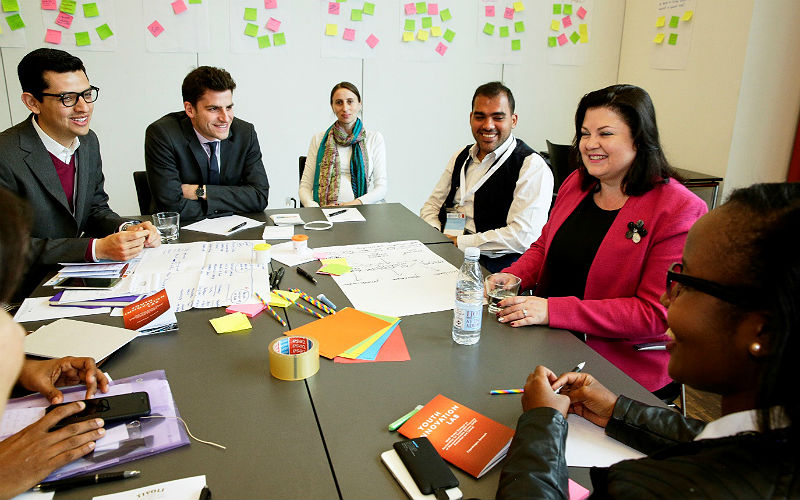
copenhagen7-800x500
Svetlana Axelrod, WHO ADG NMH, interacts with participants of the Global Dialogue
Jesper Westley

The meeting provided a platform to showcase the accomplishments since 2011, review the commitments made at the High-level meetings and other important global conferences on financing development, and emphasize the role of partnerships for mobilizing resources for national NCD responses, as well as the implementation of the 2030 Agenda for Sustainable Development.

Participants included more than 100 participants representing 56 countries worldwide, 60 participants representing various UN Agencies and more than 100 participants as non-State actors, of which more than half represented non-health sectors.

Expected outcomes for the Dialogue were met: a greater understanding of the current NCD financing landscape was well noted by participants. This effort was complemented by the launch of the Lancet Economic Series on NCDs and Economics. The Dialogue also succeeded in assessing the progress in funding national NCD responses since 2011 as well as highlighting the remaining challenges and addressing these through innovative solutions.

The Dialogue facilitated an increased multistakeholder and multisectoral dialogue and communication on how to mobilize domestic and external (bilateral and multilateral) financing streams, as well as how to incentivize the private sector to support national NCD responses.

With support and inputs from WHO technical focal points, the Dialogue provided much needed evidence, data and best practices that emphasize the importance of achieving a sustainable NCD response through improved understanding of the synergies between financing NCD responses and broader health system strengthening efforts towards universal health coverage (UHC).

Finally, the Dialogue served as an effective platform to strengthen alliances and advance multistakeholder and multisectoral partnerships for accelerating action towards sustainable financing to support SDG 3.4. The Dialogue also witnessed the announcement of various reports and commitments from several stakeholders. These included the launch of the GCM Working Group Report on how to realize governments’ commitment to provide financing for NCDs, the above-mentioned Lancet Economic Series on NCDs and Economics, and Denmark’s commitment to support the Defeat NCD Partnership and set up an SDG Fund to secure new investments for the SDGs, including SDG 3, in low- and middle- income countries.

The innovative part of the Global Dialogue was the Youth Innovation Lab formed in collaboration of WDF together with NCD Child, NCD Free, IFMSA and the YP-CDN. The Youth Lab convened 20 carefully selected young talents from all over the world to work in parallel to the Global Dialogue to provide innovative solutions to the issues being discussed at the Global Dialogue. The outcomes were then presented to the participants of the Global Dialogue and received a lot of positive feedback and appreciation. The young talents will continue working on their ideas and make sure they will be implemented.

Related