


Background
Global interest is increasing in the use of taxes to improve population health, given increased evidence on the health effects of sugar consumption, and the accumulated experience on the effectiveness of tobacco and alcohol taxes in lowering consumption. Whilst the dominant motivation has been to improve health by changing consumer behaviour, revenue considerations are also relevant. To complement existing activities in this area, WHO’s Department Health Systems Governance and Financing (HGF) convened a Strategy meeting on the use of fiscal policies for health (4-5 December 2017, Geneva, Switzerland) to enhance WHO Secretariat’s capacity to support Member States in developing and implementing fiscal policies for health.
Objectives
The objectives of this meeting were:
- To formulate a harmonized strategic framework to address WHO’s role in health taxes
- To facilitate collaboration and communication among WHO programmes and Regions;
- To improve WHO’s technical assistance to countries
Participants
There were participants from WHO Headquarters and Regional Offices from various programmes including:
- Tobacco, Alcohol and Diet
- Malaria and HIV/AIDS
- Environment and Pandemic Surveillance
Several key external partners also participated in this meeting. More information may be found in the list of participants.
Agenda
The meeting was divided into three (3) sessions:
- Public health impact of fiscal policies
- Revenue impact of fiscal policies
- Designing taxation and pricing policies
Please see full meeting agenda and presentations for more details.
Background papers
Six (6) background papers were commissioned for this meeting:
- Summary of regional and country experiences on health taxes
- The health impact of health taxes on food, alcohol, and tobacco
Request for copies of the background papers may be sent to vigoa@who.int.
- Estimating the fiscal and economic impacts of health taxes on food, alcohol and tobacco
- Designing taxation and pricing policies
- Role of WHO in south Africa SSB tax initiative
- Law and health taxes
WHO approach to health taxes
There was a general agreement that there was a need for having a unified, organization-wide approach to health taxes. There are strategic benefits to adopting a “health in all fiscal policies” approach, rather than one that is product-specific.
The approach follows a logical hierarchy:
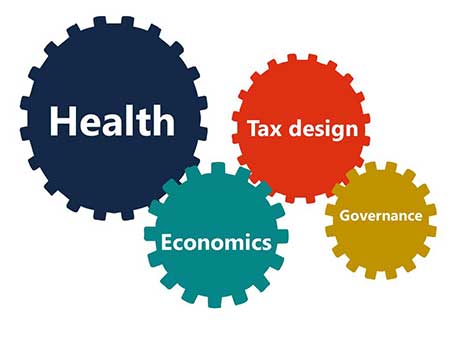
- Health - WHO is a health organization. Health taxes therefore need to be understood, first and foremost, as health protection and promotion measures. However, the effective use of health taxes requires an understanding of fiscal policy, economics, governance and law.
- Economics - Economic impacts are not the principal objective of health taxes, but they are nevertheless socially important outcomes that policy makers need to take into account. Indeed, the majority of arguments advanced against health taxes do not attempt to rebut their positive health impacts but rather to convince policy makers that the negative economic impacts of health taxes outweigh their health benefits.
- Tax design - The taxes should decrease affordability of the target commodities, therefore, the taxes should be adjusted to account for increases in consumer prices and incomes. The taxes should also discourage substitution.
- Governance and administration - National authorities seeking to implement health taxes could encounter practical challenges including weak tax administration, revenue leakages, and limited new sources of tax funds.