


T0 Initial case investigation form
Instructions
Why to use this T0 questionnaire?
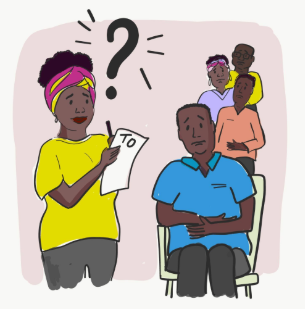
When the disease cause and the transmission of the outbreak are unclear, the T0 Initial case investigation form guides the collection of essential data.
This data describes the outbreak regarding its evolution over time (time), spread (place) and persons affected (persons) to quickly generate a hypothesis about its cause, source and transmission mode.
When to use this T0 questionnaire?
- Immediately after notification of an alert,
- When the outbreak occurs in a setting with limited human resources.
What will this T0 questionnaire allow you to do?
- confirm the outbreak quickly,
- evaluate severity and extend of the outbreak
- identify disease, or syndrome, or exposure and source of the outbreak.
How to use the T0 questionnaire?
Collect early initial and generic information from all patients by adhering to the following rules:
- Questions marked with “*” are classified as core variables (EPI core variables) for the outbreak investigation. They represent the minimum data set of variables considered necessary to conduct the analysis by time, place and persons. Collecting these core variables will allow the first rapid assessment of severity and risk of spread of the outbreak. Where resources are limited, those variables represent the minimum to collect with this form.
- “Date” format is set by default as day/month/year. Different formats are possible in the word version and in the line-list.
- For location of the patient residency, use Admin level 1 to 4 (depending on specific country administrative boundaries). The admin levels need to be set by the interviewer, the data manager or the IT expert, prior to the data collection.
a) Admin 1: province, state, territory, prefecture, region;
b) Admin 2: district, county, local government area, department, province, municipality;
c) Admin 3: sub-district, commune, zone;
d) Admin 4: community, ward, parish, commune.
4. For a more exact location of patient residency or suspected place of exposure, GPS coordinates can be collected as follows.
GPS coordinates are collected for the variables GPS residence latitude and GPS residence longitude:
- data can be obtained from a handheld GPS tracker
- data can also be obtained from a smartphone or a tablet following the steps below:
- open the Google Maps app.
- touch and hold an area of the map where you are and that isn't labeled. You'll see a red pin appearing.
- you'll see the coordinates of the red pin in the search box.
- data entered should be in decimal degrees: e.g. Latitude: 40.714234, Longitude: -74.006463.
- If “degrees/minutes/seconds” format data is collected, this needs to be converted to decimal degrees (https://www.fcc.gov/media/radio/dms-decimal)
5. “Mass gathering events” are not limited to large gatherings, but this can also refer to any event involving several persons. Specifying the type of event will reinforce the quality of the data collected. For example; a football game, wedding ceremony, family gathering, school attendance, church attendance, etc. should be recorded accurately.
Resources:
T0 initial case investigation form in PDF template: download
T0 initial case investigation form Microsoft Office word template: download (English) or download (Francais)
T0 initial case investigation form instruction notes (this form): download
Field data capture with electronic devicesT0 initial case investigation form in "Kobo-collect": download
T0 initial case investigation form in “Go data 2.0” software: contact Go Data website
T0 initial case investigation form in “EWARS in a box”: contact Christopher Haskew at haskewc@who.int
Line list (database template) for T0T0 initial case investigation form line list and data dictionary (English and Français) in Microsoft Office excel: download