
Certifying eradication of dracunculiasis
The Commission meets as and when necessary at WHO headquarters in Geneva to evaluate the status of countries applying for certification of dracunculiasis eradication and to recommend whether a particular country should be certified as free of transmission.
A country endemic for dracunculiasis reporting zero indigenous cases over a complete calendar year is deemed to have prevented transmission of guinea-worm disease and is classified as being in the precertification phase.
To be declared free of dracunculiasis, a country that has stopped transmission of the disease must have reported zero indigenous cases through active surveillance for at least 3 consecutive calendar years.
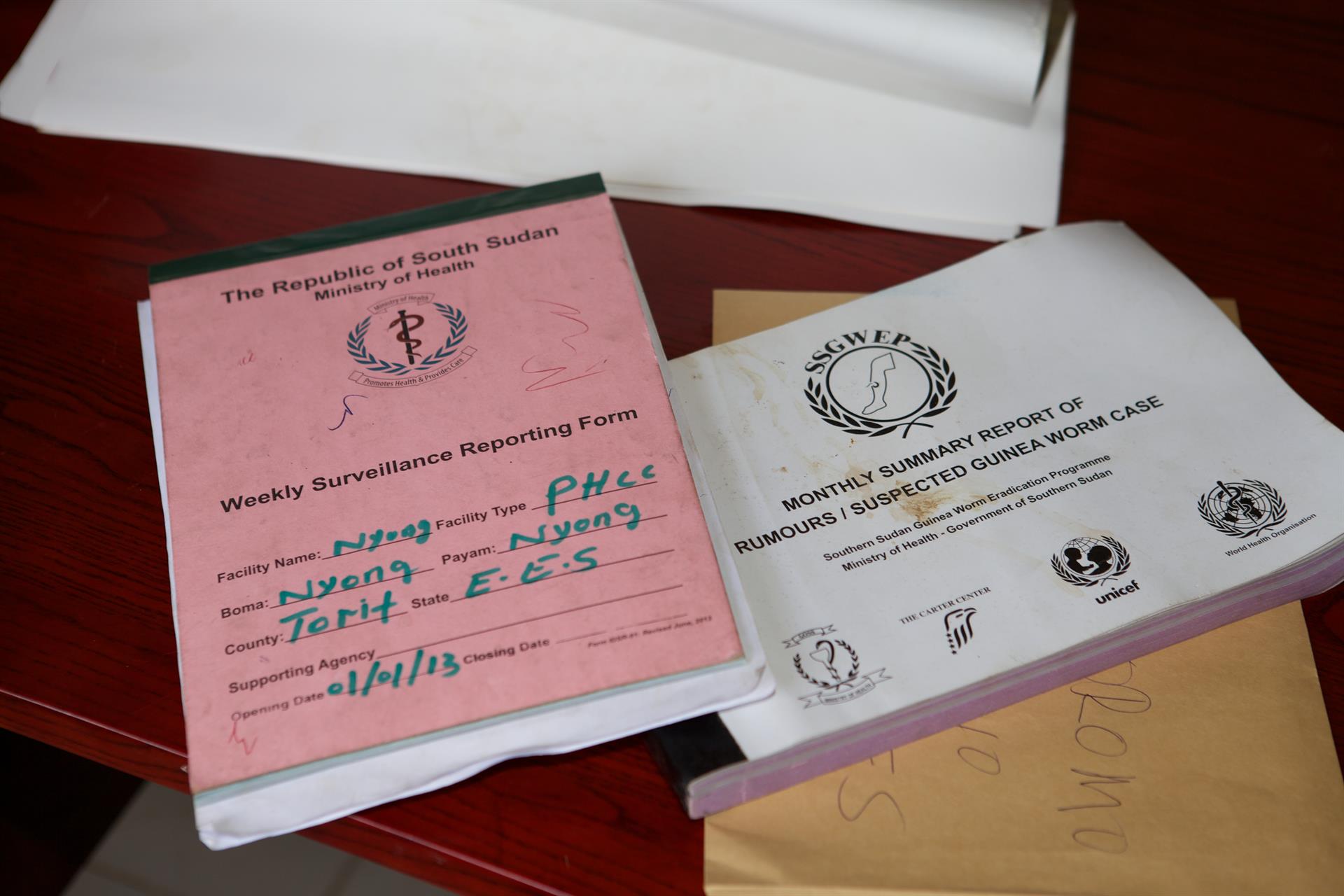
A national report should document all actions taken from the beginning of the programme, including the 3-year period, to interrupt transmission and confirm zero occurrences of guinea-worm disease cases.
After this period, an International Certification Team (ICT) visits the country to verify the information contained in the national report. During its visit, the ICT assesses the adequacy of the surveillance system and reviews records of any investigations for rumoured cases and subsequent actions taken.
Since its establishment in 1995 until February 2018, the ICCDE has met 12 times. It has certified 199 countries, territories and areas (belonging to 187 Member States) as free of dracunculiasis transmission.
The latest country to attain this status in February 2017 was Kenya, a formerly endemic country.
To declare global eradication of dracunculiasis, WHO must formally certify every individual country even if no transmission has ever been recorded in that particular country.
To declare global eradication of dracunculiasis, WHO must formally certify every individual country even if no transmission has ever been recorded in that particular country.
During the 12th meeting of the ICCDE, the following definitions were adopted.
Elimination of dracunculiasis is the confirmed absence of the emergence of adult female worms (the interruption of transmission of Dracunculus medinensis) in humans and animals for three consecutive years or longer from a country with such a low risk of reintroduction of the parasite that preventive measures could be reduced to a strict minimum.
Worldwide eradication of dracunculiasis is the confirmed absence of the emergence of adult female worms (defined as compatible with the interruption of transmission of D. medinensis) in humans and animals for three consecutive years or longer at the global level.
Similarly, both the case definition and the criteria for case containment are revised to reflect current practice.
Case definition: A case of guinea-worm disease is a person exhibiting a skin lesion with emergence of a Guinea worm, and in which the worm is confirmed in laboratory tests to be D. medinensis. That person is counted as a case only once during the calendar year, i.e. when the first worm emerges from that person. All worm specimens should be obtained from each case patient for laboratory confirmation and sent to the United States Centers for Disease Control and Prevention (CDC). All cases should be monitored at least twice per month during the remainder of the calendar year for prompt detection of possible emergence of additional guinea worms.
Criteria for a contained case: A case of guinea-worm disease is contained if all of the following conditions are met:
- the patient is detected before or within 24 hours of worm emergence; and
- the patient has not entered any water source since the worm emerged; and
- the village volunteer has properly managed the case, by cleaning and bandaging the affected limb until the worm is fully removed and by giving health education to discourage the patient from contaminating any water source (if two or more guinea worms are present, the case is not contained until the last worm is extracted); and
- temephos (Abate) is used if there is any uncertainty about contamination of sources of drinking-water, or if a source of drinking-water is known to have been contaminated.
