Expanded key messages
Malaria by numbers: global and regional malaria burden
In 2017, there were an estimated 219 million cases of malaria in 87 countries. No significant gains were made in reducing malaria cases in the period 2015-2017.
The estimated number of malaria deaths in 2017 stood at 435 000, a similar number to the previous year.
The WHO African Region continues to account for approximately 90% of malaria cases and deaths worldwide. In the 10 African countries hardest hit by malaria (Burkina Faso, Cameroon, Democratic Republic of the Congo, Ghana, Mali, Mozambique, Niger, Nigeria, Uganda and United Republic of Tanzania), there were an estimated 3.5 million more cases of malaria in 2017 over the previous year.
Estimated malaria burden by WHO region in 2017
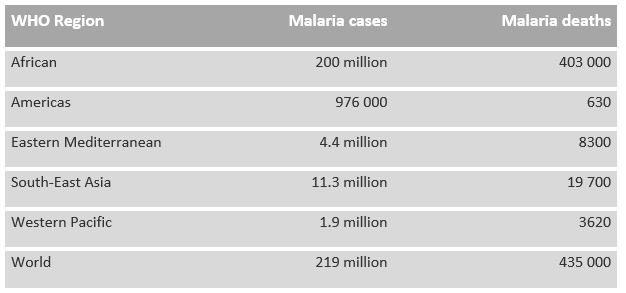
Source: World malaria report 2018
Global targets and funding
In view of recent data and trends, progress towards two critical targets of the Global Technical Strategy for Malaria 2016–2030 (GTS) – reducing malaria case incidence and death rates by at least 40% by 2020 – is off track.
Funding for the global malaria response in 2017 remained largely unchanged when compared to 2016. US$ 3.1 billion was available for global malaria control and elimination programmes in 2017, well below the GTS funding target for 2020 US $6.6 billion).
Gaps in access to core tools
The latest World malaria report highlights major coverage gaps in access to core WHO-recommended tools for preventing, detecting and treating malaria, particularly in the world’s highest burden countries.
- In 2017, half (50%) of the population at risk of malaria in Africa slept under an insecticide-treated net, a similar figure to the previous year and a marginal improvement since 2015.
- Just over 1 in 5 (22%) eligible pregnant women in Africa received the recommended three or more doses of preventive therapy in 2017, compared with 17% in 2015.
- Less than half (48%) of children with a fever in Africa were taken to a trained medical provider (2015-2017).
“High burden to high impact”
As a response to the data and trends published in the World malaria report, WHO and the RBM Partnership recently catalyzed “High burden to high impact,” a new approach to intensify support for countries that carry a high burden of malaria, particularly in Africa. The approach is founded on 4 pillars:
- Political will to reduce malaria deaths
- Strategic information to drive impact
- Better guidance, policies and strategies
- A coordinated national malaria response
Pillar 1 calls on leaders of malaria-affected countries to translate their stated political commitments into resources and tangible actions that will save more lives. To this end, campaigns that engage communities and country leaders – like “Zero malaria starts with me” – can foster an environment of accountability and action.
“Zero malaria starts with me”
The “Zero malaria” campaign – first launched in Senegal in 2014 – was officially endorsed at the African Union Summit by all African Heads of State in July 2018.
The campaign engages all members of society: political leaders who control government policy decisions and budgets; private sector companies that will benefit from a malaria-free workforce; and communities affected by malaria, whose buy-in and ownership of malaria control interventions is key to success.
Signs of hope
While progress in the global response to malaria has levelled off, a subset of countries with a low burden of malaria is moving quickly towards elimination. In 2017:
- 46 countries reported fewer than 10 000 indigenous malaria cases, up from 37 countries in 2010
- 26 countries reported fewer than 100 malaria cases, up from 15 countries in 2010.
China and El Salvador reported zero indigenous cases of malaria in 2017 – a first for both countries.
Countries that achieve at least 3 consecutive years of zero indigenous cases can apply for an official WHO certification of malaria elimination. In 2018, two countries reached this milestone: Paraguay and Uzbekistan.
Some countries with a high burden of malaria are also making strong strides in reducing their burden of the disease.
- India – a country that represents 4% of the global malaria burden – registered a 24% reduction in cases in 2017 compared to 2016.
- Other countries that noted considerable declines in cases in 2017 include Ethiopia (-8.9%), Pakistan (-20.5%) and Rwanda (-6.6%).
Prospects for new interventions
Boosting investments in the development and deployment of a new generation of malaria tools is key to achieving the 2030 global malaria targets.
For vector control, new interventions that target outdoor-biting mosquitoes are being explored. New chemical formulations to mitigate the threat of insecticide resistance are under development, as are new strategies to improve the delivery of treated nets and indoor spraying.