
WHO response
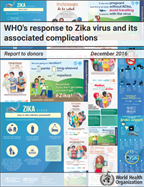
WHO's response to Zika virus and its associated complications
On 1 February 2016 WHO Director-General Margaret Chan declared that the spread of Zika virus and its associated complications constituted a public health emergency of international concern (PHEIC). On 14 February, WHO launched a global Strategic Response Framework and Joint Operations Plan, subsequently updated on 15 July, in which WHO and partners set out their strategy for preventing, detecting, and responding to Zika virus and its complications. Support from donors has ensured that this strategy has been realised.
Publication details
Publication details
Zika strategic response plan - revised for July 2016-December 2017
The Response Plan outlines 4 main objectives to support national governments and communities in preventing and managing the complications of Zika virus and mitigating the socioeconomic consequences: detection, prevention, care and support, as well as research.
Expanding health systems’ capacities in affected countries is one of the cornerstones of the Strategic Response Plan. The spread of Zika virus will have long-term health consequences for families, communities, and countries, whose health systems will be challenged to care for children born with these complications for years to come.
The Strategy also focuses on communicating risks with women of child-bearing age, pregnant women, their partners, households and communities, so that people have the information they need to protect themselves will also be central to the response.
Other elements include integrated vector management, sexual and reproductive health counselling as well as health education and care within the social and legal contexts of each country where Zika virus is being transmitted.
The plan provides the basis for coordination and collaboration among WHO and its partners so that countries’ preparedness and response capacities are supported to the fullest extent possible.
WHO Zika virus research agenda
The goal of the WHO Zika Virus Research Agenda is to support the generation of evidence needed to strengthen essential public health guidance and actions to prevent and limit the impact of Zika virus and its complications.
The Research Agenda identifies critical areas of research where WHO is uniquely placed to implement or coordinate global activities. Research and evidence are the foundation for sound health policies.
Support and harmonization of research in countries: Standardized research protocols
A document summarizes the ongoing efforts of the World Health Organization and Pan American Health Organization, Institut Pasteur and the networks of Fiocruz, CONSISE and ISARIC to generate standardized clinical and epidemiological research protocols and questionnaires to address key public health questions. Specifically, data collected using the standardized protocols will be used to refine and update recommendations for prevention of Zika virus spread, surveillance and case definitions for microcephaly, to help understand the spread, severity, spectrum and impact on the community of ZIKV and to guide public health measures, particularly for pregnant women and couples planning a pregnancy.
- Read the summary
pdf, 407kb
15 pages
Standardized research protocols
Spanish - Español
These protocols have been designed to maximize the likelihood that data and biological samples are systematically collected and shared rapidly in a format that can be easily aggregated, tabulated and analysed across many different settings globally. The protocols are listed below and can be adapted and used by research partners, Member States and the diverse institutions that comprise the global community. We encourage any and all study centres to contribute to these research efforts to better understand ZIKV.
- Case-control study to assess potential risk factors related to microcephaly including Zika virus infection during pregnancy
pdf, 1.80Mb - Prospective longitudinal cohort study of newborns and infants born to mothers exposed to Zika virus during pregnancy
pdf, 2.05Mb - Prospective longitudinal cohort study of women and newborns exposed to Zika virus during the course of pregnancy
pdf, 1.87Mb - Prospective longitudinal cohort study of Zika-infected patients to measure the persistence of Zika virus in body fluids
pdf, 502kb - Case-control study to assess potential risk factors related to Guillain-Barré Syndrome including Zika virus infection
pdf, 1.23Mb - Cross-sectional seroprevalence study of Zika virus infection in the general population
pdf, 783kb - Standardized Protocol: Natural History Protocol for Zika Virus Infection
pdf, 1.02Mb
Zika Strategic Response Plan
This Quarterly Update gives key information on the situation, the response and updated funding information for organizations working as part of the response. In accordance with standardized planning best practice it provides an update of progress against the Zika Strategic Response Plan, Revised for July 2016 – December 2017, which remains the main strategy document.
Zika virus outbreak global response - Interim report May 2016
This is an interim report on the WHO-led global response to the emerging threat posed by Zika virus. It summarises the background to the Strategic Response Framework and Joint Operations Plan published in February 2016, provides an update on some key activities conducted by WHO and its partners since, and sets out the current funding gap for critical activities until the end of June 2016, as well as the approach to setting a new strategy from July 2016 onwards.
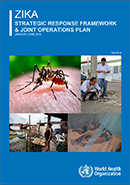
Zika strategic response framework and joint operations plan - January - June 2016
Publication details
Publication details