Excellencies, honourable ministers, distinguished delegates, representatives of the African Union, Dr Moeti, ladies and gentlemen,
I thank the government of the Republic of Chad for hosting this session. I thank the President of this country for his leadership and commitment to health. His role in mobilizing the military logistics that helped stop polio in the very challenging geography of Lake Chad was decisive. Chad has been polio-free for more than three years.
In 1996, when Nelson Mandela launched the Kick polio out of Africa campaign, the disease was paralyzing around 75 000 children in this region every year.
On 25 September, Nigeria, polio’s last sanctuary in sub-Saharan Africa, was removed from the list of polio-endemic countries. This is a stunning achievement. As recently as 2012, Nigeria was the global epicentre for polio transmission, accounting for more than half of all cases worldwide.
For well over a year, not a single child in this region has been paralyzed by wild poliovirus. This is a gift of hope for all of Africa.
As we know, this was not an easy victory. Given the obstacles that had to be overcome, it offers proof of the power of commitment by leadership at political, religious, and community levels. This is what Africa’s collective will and determination can achieve.
In Nigeria, the establishment of a national polio emergency operations centre was decisive. But the true game changer was the enforcement of an accountability framework by government at all levels, including partner agencies.
We must also acknowledge the courage of more than 200 000 volunteers across the country who repeatedly immunized more than 45 million children, often at great personal risk.
As we all know, this triumph over a dreaded disease is not yet secure. African leaders are fully aware of the need to maintain high immunization coverage and intense surveillance. If no further cases are detected, the African Region can be certified polio-free as early as 2017.
Polio, which can paralyze a child within hours after infection, is a disease that cannot be controlled. It must be eradicated.
Ladies and gentlemen,
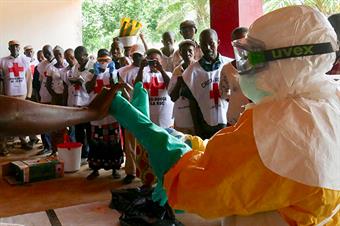
The outbreak of Ebola virus disease in West Africa is not yet over, but we are close. For the past 2 months, we have been in a phase of tracking and breaking every last chain of transmission.
Sierra Leone has interrupted transmission. Guinea’s last known case has recovered and the countdown in that country has begun. Last week, new cases were confirmed in Liberia, clearly signalling the need for continued vigilance. The cases were detected quickly, and the government’s response to this flare-up has been vigorous.
In this year of transition, as we move to a new development agenda, as we watch the last few cases of Ebola, as the world considers what may be its last chance to save the planet, I have one piece of advice for you.
State your needs, whether for affordable medicines or the energy to power your economies, but also showcase your successes. Ebola in Africa is 2 stories. One of a devastating humanitarian crisis. A second of remarkable success.
Like the countries of West Africa, the Democratic Republic of Congo is poor and has an inadequate health system, especially in remote rural areas. But the country was prepared when its seventh Ebola outbreak began in 2014.
The government could immediately activate well-tested emergency response plans. The outbreak lasted less than 2 months, causing 66 cases and 49 deaths.
Lagos, Nigeria likely provides the best proof that a large outbreak can be prevented, even in a teeming city with a population of more than 20 million people. An immediate response, combined with world-class epidemiological detective work, held the number of cases in Lagos to just 15.
After their first imported cases, Senegal and Mali likewise prevented onward transmission or held it to just a handful of cases.
Ebola put the spotlight on some of the worst things that can happen when health systems and infrastructures are weak or broken. Nearly all of the panels, committees, and conferences looking at lessons from Ebola recognize that strengthening health systems must be part of the global health security agenda.
Another overarching conclusion is this. Outbreaks of new and re-emerging diseases cannot be reliably predicted, but large, severe, and sustained outbreaks can be prevented through preparedness, quick detection, and a forceful response. Again, doing so depends on a well-functioning health system.
As a consequence of the outbreak, this region is receiving significant technical and financial support, mainly from China and the United States of America, to establish an Africa Centre for Disease Control. Again, the emphasis is on capacity building for early detection and response.
No one wants any country in Africa to experience a calamity like Ebola, ever again.
At the September UN sustainable development summit, China announced the establishment of a fund, with an initial contribution of US$ 2 billion, to support south-south cooperation, especially with least developed countries.
The United States of America has announced major funding to develop IHR (International Health Regulations 2005) capacities in several developing countries, mainly in Africa. Other countries and initiatives have recently announced programmes to improve surveillance, train African scientists in outbreak response, and strengthen laboratory services.
Ladies and gentlemen,
You will need this support. The agenda for sustainable development is supremely ambitious.
The world is far more complex, and far more dangerous, than it was 15 years ago. The health challenges are far more complex, and far more numerous. The number of goals has increased from 8 to 17. The number of targets grew eight-fold, from 21 to 169.
The political and financial contexts are less promising than they were 15 years ago. In many wealthy countries, economic insecurity, domestic cuts in public services, and growing inequality reduce political interest in international development and increase public hostility to foreign aid.
Consensus is growing that the SDGs will not be primarily financed from aid budgets. Moving forward, countries are expected to make their tax systems more efficient and introduce measures to combat tax evasion and illicit tax flows. This marks a fundamental change in patterns of health financing, where the burden is placed on domestic budgets.
At the same time, we need to remember that, during the MDG era, which saw large increases in financing for health, the average low-income country still financed 75% of its total health expenditure from domestic resources.
In the new agenda, business as usual will not work. The emphasis is firmly placed on implementation within countries, in line with the setting of realistic national targets.
The culture of measurement and accountability, introduced during the MDG era, is now an established expectation for any health initiative. Fortunately, progress towards the 13 targets under the health goal can be measured with a great deal of precision.
Health system reforms that reduce waste and inefficiency help ensure the most effective use of domestic resources. Your report on people-centred integrated service delivery moves in the right direction, as does the report on human resources for health.
As I hear over and over, broad collaboration with non-health sectors, civil society organizations, and the private sector is the only way to approach such ambitious targets and goals.
Health benefits greatly from the agenda’s broad and integrated approach that addresses multiple economic, environmental, and social determinants of health. This gives ministries of health a framework for promoting policy coherence and integrated action.
Above all, the SDGs recognize universal health coverage (UHC) as a pro-poor pillar of sustainable development. UHC is the health target that underpins all others and is key to their implementation. It transforms lives, and it transforms livelihoods.
In health care, UHC is the ultimate expression of fairness. It means ensuring that everyone can obtain essential health services of high quality without suffering financial hardship. The evidence is now overwhelming. Providing quality health services free at the point of delivery helps end poverty, boosts economic growth, and saves lives.
UHC provides the platform for coherent integrated service delivery. It counters the fragmentation caused by single-disease initiatives during the previous development era. Again, this is a fundamental change that should boost health progress in Africa.
Thank you.