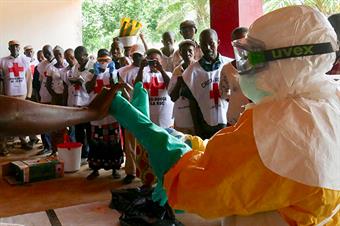

Honourable ministers, colleagues in the UN system, distinguished guests, ladies and gentlemen, the Ebola outbreak laid bare the world’s inability, at national, regional, and international levels, to cope with a disease event that was both severe and sustained. All capacities needed for an adequate response fell short, from surveillance and laboratory systems, to the availability of medical teams and hospital beds, to the logistics for moving supplies.
The Zika outbreak revealed a different set of weaknesses. These include the inadequate provision of sexual and family planning services in Latin America and the Caribbean, which has the highest proportion of unintended pregnancies in the world.
They also include the lack of facilities and programmes to care for babies born with severe neurological complications, and inadequate tools for mosquito control.
Many of these deficiencies will take some time to correct. But five changes, aimed at improving the global architecture for health emergencies, have moved forward quickly.
First, the establishment of a unified programme for all health emergencies has given WHO a new operational arm, with its own streamlined administrative and business procedures, that are consistently applied at headquarters, in regional offices, and in country offices.
The programme’s design aligns with the principles of a single programme, with one clear line of authority, one workforce, one budget, one set of rules and processes, and one set of standard performance metrics. The programme incorporates an incident management system and has provisions for the systematic grading of emergencies.
Second, the international community is making a much greater effort to help vulnerable countries develop the core capacities needed to implement the International Health Regulations. A standardized tool for the joint external evaluation of gaps in preparedness and response capacities is now being systematically applied.
As many have noted, universal health coverage is the first line of defence against the threat from emerging and re-emerging diseases. District health systems are the lifeline for community health, and the frontline for the surveillance and information systems needed to detect and contain outbreaks early.
Third, to build surge capacity, WHO has a programme dedicated to the training and certification of national emergency medical teams. WHO introduced a registry of qualified teams that can be closely matched with the needs of individual emergencies.
The registry speeds up the deployment of teams to augment the Global Outbreak Alert and Response Network, thus expanding regional and global surge capacity during emergencies.
Fourth, we are working through OCHA on ways to activate existing mechanisms for the coordination of humanitarian affairs during health emergencies.
The Principles of the Interagency Standing Committee agreed in June to develop SOPs for managing infectious hazards in the current humanitarian architecture. This work is under way.
In addition, WHO fully supports the World Bank’s Pandemic Emergency Financing Facility, which has created the first-ever insurance market for pandemic risk.
Finally, WHO has moved forward with its R&D blueprint that aims to expedite the development of new medical products during health emergencies. The blueprint has features, like standard clinical trial protocols and pre-defined regulatory pathways, which help save time in making new products available.
These five changes are significantly transforming the global health architecture, increasing its ability to prevent, detect, and respond to future health emergencies.
To ensure these changes continue to move forward, we need adequate financial support. The budget for the new WHO programme has three tiers: core funding for essential capacity, the contingency fund for immediate response, and project funding for events or through appeals.
The programme currently has an immediate funding gap of $115 million core funding, and $69 million for the contingency fund. The budget line for humanitarian appeals has a gap of around $450 million. The responses to Zika and yellow fever are also grossly underfunded.
I have used the WHO regular budget to invest $80 million in the programme. I call on donor partners to fill the financing gaps.
The programme can be successful only when its foundations are in place.
Thank you.