Tehran, Islamic Republic of Iran
Your Excellency President Rouhani,
President of the Regional Committee,
Honourable Ministers and Heads of Delegation,
Dr Al Mandhari, Regional Director for the Eastern Mediterranean,
Distinguished guests, colleagues and friends,
Salam! It’s a great honour to be here in Iran.
I offer my deep thanks and respect to Your Excellency for your warm welcome and hospitality, and for hosting the Regional Committee meeting for the Eastern Mediterranean.
Iran is a health leader in the region, and is rightly recognized for its approach to primary health care.
This has contributed significantly to major improvements in maternal and child health, and prevention and control of noncommunicable diseases.
WHO welcomes President Rouhani’s commitment to delivering health care for all Iranian citizens through the Health Transformation Plan.
Public investments in health have increased, and out-of-pocket spending has decreased. Health workers are now better paid, infrastructure has been modernized and insurance coverage is near universal.
Congratulations.
Iran is indeed an example from which the region and the world can learn.
Of course, there is always room for improvement. WHO is committed to working with the Government of Iran to find ways to improve efficiency and sustainability, to take advantage of the opportunities offered by big data and artificial intelligence, and to meet the needs of your ageing population.
===
Excellencies,
As you know, and as the Regional Director’s report describes, your region faces many challenges.
The Global Monitoring Report on Universal Health Coverage shows that between 2000 and 2015, this region saw the highest average increase in the number of people exposed to catastrophic health spending.
Within the region, there are large variations in out-of-pocket spending, from less than 1% to more than 40%.
And you are all painfully aware of the impact of health emergencies in the region, including polio, which remains a public health emergency of international concern.
===
Despite these challenges, there are many reasons for optimism.
Last year, you adopted Vision 2023, the regional vision document, with its four strategic priorities, which are beautifully aligned with the General Programme of Work and the Sustainable Development Goals.
There is clearly strong political commitment for universal health coverage.
Last year, you came together to endorse the Salalah declaration on UHC
That commitment is now being translated into policy in many countries.
WHO is supporting Afghanistan, Egypt, Iran, Jordan, Lebanon, Morocco and Pakistan to develop pilot benefit packages.
We’ve worked with Iraq, Morocco, Oman, Palestine and Sudan to review or develop health financing strategies.
We’ve also worked with Somalia, Tunisia and others to strengthen health system governance.
A regional parliamentary forum for UHC was initiated to promote the
leadership role of parliamentarians.
This is very important. Later today I will be travelling to Belgrade, Serbia, to attend the congress of the Inter-Parliamentary Union, where we expect a resolution on universal health coverage to be passed this week.
Parliamentarians have a key role to play in translating political commitment into policy realities and improved health outcomes.
Egypt’s hepatitis programme is a perfect example, and an incredible public health achievement.
WHO has also supported Pakistan to assess its hepatitis diagnosis capacity, and to integrate services for HIV, tuberculosis and hepatitis services for key populations.
And there are many other causes for celebration, which my brother Ahmed has already described.
===
Your agenda this week includes several items to build on these successes and address the challenges you face.
Although under-5 mortality has been reduced by half in the past 30 years, your region still has the world’s second-highest rate of neonatal mortality.
This is an urgent priority.
The regional implementation framework for newborn, child and adolescent health presents a clear roadmap, with concrete actions and milestones, for ensuring more babies survive their first month of life.
The plan includes ensuring an adequate number and distribution of health workers.
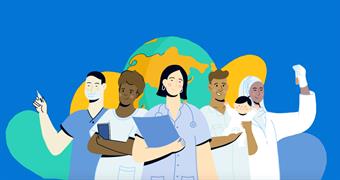
A strong and skilled health workforce is vital not only for newborn health, but for every stage of life. There is no health without health workers.
Nurses and midwives are an especially important part of every health system because of the range of services they provide – especially primary health care services such as immunizations, maternity care and more.
Although the global shortage of nurses and midwives is expected to decline by 2030, that shortage is predicted to increase in the Eastern Mediterranean Region.
This is a very disturbing forecast.
The resolution on strengthening the nursing workforce is therefore an important step towards addressing this gap. It includes several recommendations for countries and for WHO, and I can assure you that WHO is committed to fulfilling its obligations.
To honour the contribution of nurses and midwives, the World Health Assembly has agreed that in 2020 we will celebrate the International Year of the Nurse and the Midwife. This will be an opportunity to mark the 200th anniversary of the birth of Florence Nightingale, and to celebrate the work of all our nurses and midwives.
As part of that celebration, we are also proposing that every country bring one nurse and one midwife to the World Health Assembly next year. The world must hear their voices and their stories.
===
Although primary health care is the foundation of universal health coverage, all health systems also need hospitals that provide high-quality, person-centred care.
The framework for action for the hospital sector will help countries to realize this vision, with interventions at both the system and facility level.
Noncommunicable diseases continue to take an unacceptable toll on the region. At current trends, the region will not achieve SDG target on NCDs.
This is one of only two regions in which tobacco use is increasing.
The resolution on accelerating regional implementation of the Political Declaration of the High-level Meeting on NCDs is therefore very timely. The Tehran Declaration on Healthy Lifestyles provides a clear statement on the fundamental importance of promoting health and preventing disease.
And finally, the Regional framework for action to strengthen the public health response to substance use provides countries with a clear path towards providing services for some of the most vulnerable people in our societies.
===
Your Excellency, colleagues and friends,
This is a broad range of issues that demand your attention.
We know that to be successful and to keep making progress towards the Sustainable Development Goals, you rely on WHO’s support and expertise.
But we also know that WHO needs to change to give you that support at the level you expect. Allow me now to say a few words about WHO’s transformation project.
Our transformation is built on five main pillars: a new strategy; new processes; a new operating model; a new culture; and a new approach to partnerships.
===
Excellencies,
Let me finish with three challenges for the next 12 months.
First, the burning challenge of reducing neonatal mortality. You have rightly identified this as a key priority.
No community, nation or region can thrive when it loses so many of its next generation.
I urge you all to act on the recommendations of the implementation framework with a sense of urgency.
Second, the challenge of strengthening the health workforce.
A country can have the best hospitals, the most modern equipment and shelves full of medicines, but without skilled health workers, it does not have a health system.
Investing in health workers is not a cost, it’s an investment that pays a triple dividend, for health, gender equality and economic growth.
Third, the challenge of forging ahead, even in the midst of crisis.
Our commitment to health for all is not a commitment only for times of peace and stability. It’s a commitment for all times, and all circumstances.
In fact, it’s a commitment that is even more important in situations of conflict and other humanitarian crisis.
It’s a commitment to defend the right to health, and to serve the vulnerable.
Sometimes, the difficulties we face can be daunting to the point of seeming insurmountable.
But they never are. There is ample evidence in this region that with strong political commitment, courageous decision-making and careful implementation, we can achieve the world we hope for.
We must never lose sight of our vision: a region in which people not only survive, but thrive. A region in which health becomes a platform for individuals, families, communities and nations to flourish.
That is the world and the region I am working for. And I am committed to working with all of you to achieve it.
Thank you so much. Moteshakeram. Shukraan jazeelan. Merci beaucoup.