Happy New Year, good morning, and welcome once again to Geneva.
It’s such a wonderful occasion, because this year as you know we will be discussing the programme budget.
I would like to start not with the programme budget, but with a story about WHO’s work to share with you what our colleagues go through every single day.
This was on November 16. Our coordinator from Beni, his name is Boubacar Diallo, called. It was around 7pm. To be accurate, actually, 7:03.
I could hear nervousness.
He said, “We’re really terrified.” There is very heavy gunfire in the city, and some of the shells are actually landing on our roof. Tedros, please pray for us.” That was what he said.
Then I told him I could hear the gunfire because it was loud and clear. And I can understand how you feel being there, because it’s even terrifying for me, hearing it through the telephone.
But next, after discussing it with his colleagues, I was surprised to hear what they said:
“We will not give up, we will continue the fight. The only thing we need is more protection.”
Based on their request we reported to the UN Security Council. Thanks to Sweden, Ethiopia, and the chair then was Bolivia, we had a resolution from the Security Council, strong support from the Secretary-General, strong support from the UN Department of Peacekeeping Operations, and we had more troops on the ground. With commitment from MONUSCO, they have now better protection.
But it doesn’t stop there.
During Christmas, we were discussing with the Minister of Health of the Democratic Republic of the Congo, and we agreed that we should visit our colleagues in the field. As you know, colleagues in the field feel the worst when it’s during holidays.
So we agreed for the Minister to be with our responders on the ground on Christmas Day, and for me and my colleagues from here to be with our responders on New Year’s Day.
This was to show our respect and to show them that although they’re away from their family, they have family – us.
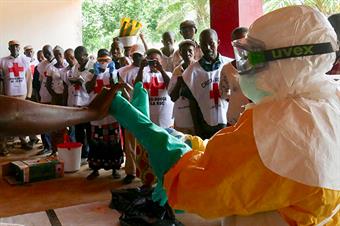
But again, during New Year’s Day, while I was there, one thing I observed really touched me deeply. I thought they would take a break on New Year’s Day, but they were working. On New Year’s Eve, they were working.
The worst thing though is during New Year’s Day while they were working, one vaccination team was attacked by a mob.
As you know, not only is there a security problem because of armed groups operating in North Kivu, but there was also protests because of the election problems.
So one of our teams was attacked and one of our responders sustained a head injury. During that visit we tried to manage the ordeal by evacuating the person who was injured.
The reason I’m telling you all this is to really show you, from what I saw on the ground, through what sort of ordeal our colleagues are passing.
Of course, the guy who was injured, Charles, is back to work now after the evacuation and treatment. That’s good news. But still it’s important to remember, and I ask you to remember not just Boubacar and Charles and others who are putting themselves at risk, but to remember the people they are there to serve, those who are affected by Ebola.
The current Ebola outbreak is just one example of the incredible work that WHO staff, with other partners, are doing every day all over the world to promote health, keep the world safe, and serve the vulnerable.
As a result, we have a long list of achievements to be proud of over the past 12 months. People are working very hard.
We have a new General Programme of Work that was finalized ahead of schedule, based on the Sustainable Development Goals.
We launched the first investment case in WHO’s history.
We have supported countries including Kenya, India, Greece and others on the road towards universal health coverage.
We have responded to 66 emergencies in 47 countries.
We have launched new initiatives to eliminate cervical cancer and trans-fats.
We initiated a new strategy to reinvigorate the response to malaria, which we call the “High Burden, High Impact” strategy.
We launched a new effort to find and treat 40 million people with tuberculosis by 2022, in partnership with the Stop TB Partnership and the Global Fund.
We hosted High-Level Meetings on tuberculosis and noncommunicable diseases at the UN General Assembly.
The High-Level Commission on NCDs delivered its report and recommendations.
And in the Astana Declaration, we highlighted the vital importance of primary health care as the foundation for universal health coverage.
I could go on and on, but I think I’d better stop there.
2019 promises to be just as fruitful, or even more so.
As of the first of January, our new GPW has come into effect.
We have made a New Year’s resolution.
In fact, we have made three resolutions:
1 billion more people benefiting from universal health coverage;
1 billion more people better protected from health emergencies;
And 1 billion more people enjoying better health and well-being.
These are the commitments we have made, the targets we have set, for the next five years.
It’s ambitious. The strategic plan, or GPW, is ambitious because the Sustainable Development Goals are ambitious, and the GPW or strategic plan is drawn from the Sustainable Development Goals.
So these are the targets we must reach together if we are to get on track, and stay on track, for the Sustainable Development Goals.
Now we must move from what we want to achieve to how we’re going to achieve it.
Now the rubber hits the road.
Now we must translate the ambitions of the GPW and the SDGs into everyday realities.
An essential part of that is the programme budget.
We have said consistently that WHO cannot keep working the way it has worked.
We have said that WHO must work in a more effective and efficient way to deliver even better value for money.
We have said that WHO must deliver impact in countries.
We have said we must break the silos.
We have said we must transform.
This is the budget that enables us to do all those things.
This is the budget that underpins a very different way of working.
At its heart are three overarching themes:
First, it’s about ensuring our normative and technical work is consistently world-class and is translated into a measurable impact in human health – because normative and technical work is central to WHO.
Outputs are not ends in themselves – we must focus on outputs that drive outcomes. That’s why the impact framework is important, and why we will continue to work with you to get it right.
Second, it’s about putting countries at the centre by allowing country needs and demands to drive our work, because it’s country priorities that should be our priorities.
Through Member State resolutions and policy dialogue, we must ensure that country needs drive supply from the secretariat.
And third, it’s about a more integrated, systems approach to delivering results, rather than one that focuses on disease-specific programmes.
We preach integrated care rather than fragmented programmes.
We must walk the talk.
We understand that this is a different budget, and we’re committed to working with all Member States to make sure this is a budget you can get behind.
We’re convinced that this is the right budget for the World Health Organization.
The programme budget is closely aligned with the investment case we launched last year, as you remember – the first in WHO’s history – which outlines the impact we could deliver with the right resources.
The investment case estimates that achieving the triple billion targets could save up to 30 million lives and add up to 100 million years of healthy living to the world’s population by 2023.
But the benefits go beyond health. We also estimate that achieving the triple billion targets could add between 2% and 4% of economic growth in low and middle-income countries.
To deliver that impact, we estimate that WHO needs 14.1 billion U.S. dollars over the next five years, or about 2.8 billion dollars a year.
Accordingly, we’re asking for a 13% increase in the base budget compared with the previous biennium.
This is a relatively modest increase compared with the ambitions of the GPW, which was developed based on the ambitious Sustainable Development Goals that the whole world committed to in September 2015.
And it’s still below what we have outlined in the investment case. So it’s a modest request.
We’re also asking for Member States to support us with more flexible, more predictable, and less fragmented funding.
As you know, at present we manage close to 3000 grants, some for very small amounts. This stresses our systems, drives fragmentation, and prevents us from focusing on the big issues. We must reduce the number of pots. Managing 3000 grants is, to be honest, a crisis. You have to help us. Unless we get support from donors and partners, this thing cannot be resolved. But it’s stressing the system, and it’s been stressing the system for many years.
We thank those Member States who are supporting us with more flexible funding and less pots. This is a trend that we hope will continue. It’s a trend that is fundamental to our transformation.
The biggest part of the increase we are asking for is to enhance country capacity.
This is an essential shift to ensure that our normative, technical products match country needs, and are translated into policies and plans that deliver an impact.
The other significant shift in this budget is away from disease-specific programmes towards a more integrated, systems approach.
Of course, we will continue to work on specific diseases – both the GPW and the Sustainable Development Goals include disease-specific targets.
But the way we fund those programmes is changing.
To break the silos, avoid duplication and accelerate progress, departments will work together to deliver shared outputs for shared outcomes.
Where funds are earmarked, we will encourage Member States and other donors to earmark them for outcomes, instead of for disease-specific programmes.
We will have agile teams that really link all the programmes and help us build a seamless organization. This is part of the transformation agenda.
This is in line with the approach to health systems and universal health coverage that are at the heart of the General Programme of Work.
You will be hearing a more detailed presentation on the budget from Imre Hollo, my colleague, and practical examples of what the budget will look like at the programme level.
The bottom line is that the programme budget is a platform for delivering impact and value for money.
It’s also a key building block of the overall transformation process.
I will say more about the transformation in my speech to the Executive Board on Thursday, and you will hear more about it at this meeting from Bruce Aylward, but let me make a few brief comments.
One thing I assure you is, when the transformation plan is implemented, it will change our organization significantly and positively – something that you will be proud of.
The transformation is all about making sure that WHO is an organization that’s capable of delivering the GPW and the Sustainable Development Goals.
It’s about positioning us for success.
Essentially, there are four components to the transformation: a new strategy, new processes, a new operating model, and a new culture. Without mindset change, I don’t think we can change the way we do things. That’s why I’m stressing the new culture.
The first of those, a new strategy, was the major focus of the first year, as we worked hard to develop the GPW.
At the same time, we have identified several key processes that we must do differently to deliver the strategy. The first of them is the programme budget. Others relating to technical work, external relations and business and administration, will follow. The processes cover 13 areas. This will change many of the processes that we use now beyond recognition and make the processes more robust and agile.
The third component is a new operating model. The Regional Directors and I have talked extensively about which model will be the best to support the processes and deliver the strategy. The new operating model must enable us to work seamlessly across all three levels of the organization. We will have more news on that in the coming weeks.
And finally, success depends on developing a high-performance culture in WHO that can deliver results. After wide consultation with the staff, we have now drafted a preliminary values charter that describes who we are – that is, our DNA.
One of these key values is integrity. Together, we are committed to a culture of honesty, transparency, accountability and respect.
Which is why it is always distressing to hear allegations of WHO staff not behaving in that way.
Last year, as you may know, I received an email containing several allegations of misconduct by WHO personnel, and expressing concerns about a lack of diversity in one cluster.
We know that WHO needs to be more diverse. This was not news to us. In fact, if you remember, it’s something I advocated for in my campaign, and that I started addressing as soon as I took office.
We knew the headquarters was not diverse, and that’s why it was part of my campaign.
As you know, we started with the senior management, because that was the easiest to start with, to address the problem of diversity. It’s now one of the most diverse of any UN agency – 64% women, and all regions are represented in the top management.
But we’re not satisfied with that, so we have set ourselves a target in the GPW to increase the number of headquarters directors who come from developing countries to at least one third by 2023, from less than 20% in 2017.
We even introduced quick wins in our recruitment process, and even at director level, the quick wins are delivering. I will tell you about the recent recruitment we did at D2 level: one is from Argentina, one is from India and the Netherlands, the third is from Mozambique, the fourth is from Tanzania, and the fifth is from the United States.
If you take the number of directors from Africa, when I started there was only one person, and he retired, actually, immediately when I joined. We now have four directors from Africa.
But I have to assure you also that diversification is not about Africa only, it’s about the whole world, because there are regions and countries who are also less represented or not represented, and we have to deliver on diversifying the World Health Organization in its totality, because the World Health Organization belongs to the world.
But still, with this result, we’re not satisfied. That’s why I was saying we have to go further. So as part of the transformation, we’re redesigning the entire recruitment process. We’re happy the quick wins are delivering, but we have to redesign it further. We’re not satisfied. Even after the redesigning we will not be satisfied, because we have to take change as a constant, and we pledge continuous improvement.
So we’ve already realized some quick wins, and we are ready to make further improvements with the new redesign, and we will continue.
And as you know, we’re also reforming the global internship programme, with a target of receiving 50% of interns from low- and middle-income countries by 2022. We did quick wins also in the interns, and there is a change in the mix of interns we received this year. By 2020, there will be a significant change in the composition of interns: we will expect more from mid- and low-income countries.
But we won’t stop here either. We are committed to continuous improvement in everything we do.
That’s what I assure you. We will not be satisfied by whatever change we make. We’re poised to make continuous improvement for our organization and for WHO to be ahead of the curve in many things we do.
As I said, the email also contained specific allegations of misconduct, which I have referred to the Office of Internal Oversight, which is looking into them according to our established procedures.
I cannot comment on those allegations given they are under independent investigation, but I can assure you that we want to know the truth more than anyone, and we will do everything in our power to find the truth.
If we’re committed to continuous improvement, the truth we get, or the feedback we get, will always help us to grow.
We take these matters extremely seriously.
By the end of this week, the Office of Internal Oversight will have completed its preliminary review of the individual allegations identified in the email. We will then know how many of those allegations will need further investigation.
While doing that, with our RDs we’re making regular consultations, I have also invited the Independent Expert Oversight Advisory Committee, which is chaired by Dr Wilson, and the Independent Oversight and Advisory Committee, which is chaired by Professor Felicity Harvey, and I have decided to invite external audit to be involved.
Why are we doing this? Because we want to know the truth.
The internal oversight service is independent, as you know. It has dual accountabilities – it’s accountable to me, but at the same time accountable to IEOAC, an independent body. It doesn’t even need my approval when they prepare a report, they can just release it.
So that’s independent, but at the same time, we’re involving all our independent mechanisms, including external audit.
So we’re doing it as robustly as possible in order to get the truth, as I said.
Any substantiated allegations will be reported to Member States using the procedures you know – the IEOAC which reports to PBAC, and IOAC that reports to the board.
As I said, we are committed to creating a safe, fair, open and transparent organization. We have zero tolerance for misconduct and discrimination of any kind.
We are also committed to due process and the presumption of innocence. We should uphold that, and I know you agree.
We have enhanced the mechanisms by which staff can report misconduct, and more than 95% of staff – myself included – have been trained in how to identify and report sexual harassment and abuse.
So I’m compliant with the training too, because no one should be above the rules.
In summary: we have good processes, and we’re using those processes.
At the same time, we know that every organization can learn and improve. We welcome suggestions about how the investigative process can be improved. That’s how organizations can learn and grow, because we’re committed to learning, and we want WHO to be a learning organization.
We know you might have more questions. I can answer some of your questions during the discussion.
So in summary, I would like to assure you that we have identified the problems that you see in the email even before the email, and we have been working on that.
And second, I would like to assure you that we want to know the truth more than anybody else, because this organization can do better only when we go for the truth, and we will do everything.
I would like to also assure you of the commitment and ownership of the leadership, both at headquarters and the regions.
Once again, thank you for your support for WHO over the past year. We count on your continued support in the year ahead, not just for our Organization, but for the children, women and men we serve in every country, every day.
I look forward to working with all of you to promote health, keep the world safe, and serve the vulnerable.
Thank you very much.