

Surveillance
One of the highest priorities of global dracunculiasis eradication is to improve surveillance and reporting of the disease, even zero cases, nationally and internationally.
Effective surveillance will help achieve the following objectives:
- Identify all affected villages and detect all human cases and infected animals
- Mobilize political and financial support
- Plan and implement interventions to interrupt transmission
- Confirm that eradication is achieved.
The goal of surveillance is to collect, analyse, interpret and disseminate information that will help towards interrupting transmission, and to rapidly detect and contain any cases that might occur, in order to prevent further transmission in countries that have interrupted transmission.
Case definition
A case of guinea-worm disease is a person exhibiting a skin lesion with emergence of a guinea worm, ideally with laboratory confirmation. That person is counted as a case only once during the calendar year, i.e. when the first guinea worm emerged from that person.
All worm specimens should be obtained from each case for laboratory confirmation and sent to the WHO Collaborating Center for Research, Training, and Control of Dracunculiasis at the United States Centers for Disease Control and Prevention (CDC). All cases should be monitored at least twice per month during the remainder of the calendar year in order to promptly detect any possible additional guinea worms.
Active surveillance
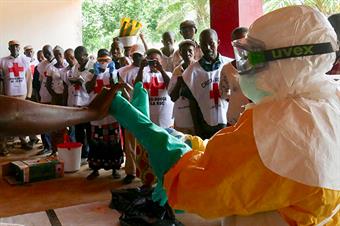
In countries where dracunculiasis is endemic, village volunteers in villages under active surveillance have a key role to play in detecting cases in the community. Infected people are often immobilized during the acute stage of the infection and health facilities are usually remote from villages.
Precertification surveillance
Surveillance of dracunculiasis during the precertification phase starts one year after the last indigenous case has been reported. The following measures should be carried out during this phase.
- Enhance the sensitivity of case detection nationwide by promoting a high degree of public awareness of dracunculiasis and its eradication, of the importance and need of reporting cases of dracunculiasis, of offering cash rewards for voluntary reporting of cases, and of the procedure for the containment of cases.
- Maintain, or institute, compulsory notification of cases of dracunculiasis by all units (e.g. primary health-care post, health centres and hospitals) of the national passive disease surveillance systems (e.g. Integrated Disease Surveillance and Response (IDSR) and Health Information Management System (HMIS).
- Continue village-based surveillance in recently and formerly endemic villages for at least 3 consecutive years.
- Maintain a register of rumoured or suspected cases of dracunculiasis infections either reported or discovered during the precertification phase, and indicate for each confirmed case whether it was imported (by tracing the case to its origin) or indigenous.
- Incorporate surveillance of other diseases or other health and development activities into the surveillance system for dracunculiasis, or vice versa (e.g. AFP [acute flaccid paralysis] surveillance, National Immunization Days, mass drug administration, NTD control programmes).
- Conduct at least one active case-detection survey, village by village, in formerly endemic areas, preferably during the transmission season; use school-based and market-based surveys.
Surveillance indicators
Coverage of surveillance is considered adequate if the following conditions have been fulfilled:
- 85% or more of villages under active surveillance and/or districts have submitted their report monthly; or
- each village under active surveillance and/or district has reported monthly for at least 9 out of 12 months
- 50% of the general population knows about the reward for reporting guinea-worm disease;
- 80% of population in the formerly endemic region/province/state knows the amount of the reward for reporting guinea-worm disease.
Even after certification, surveillance should be maintained until global eradication is declared.