
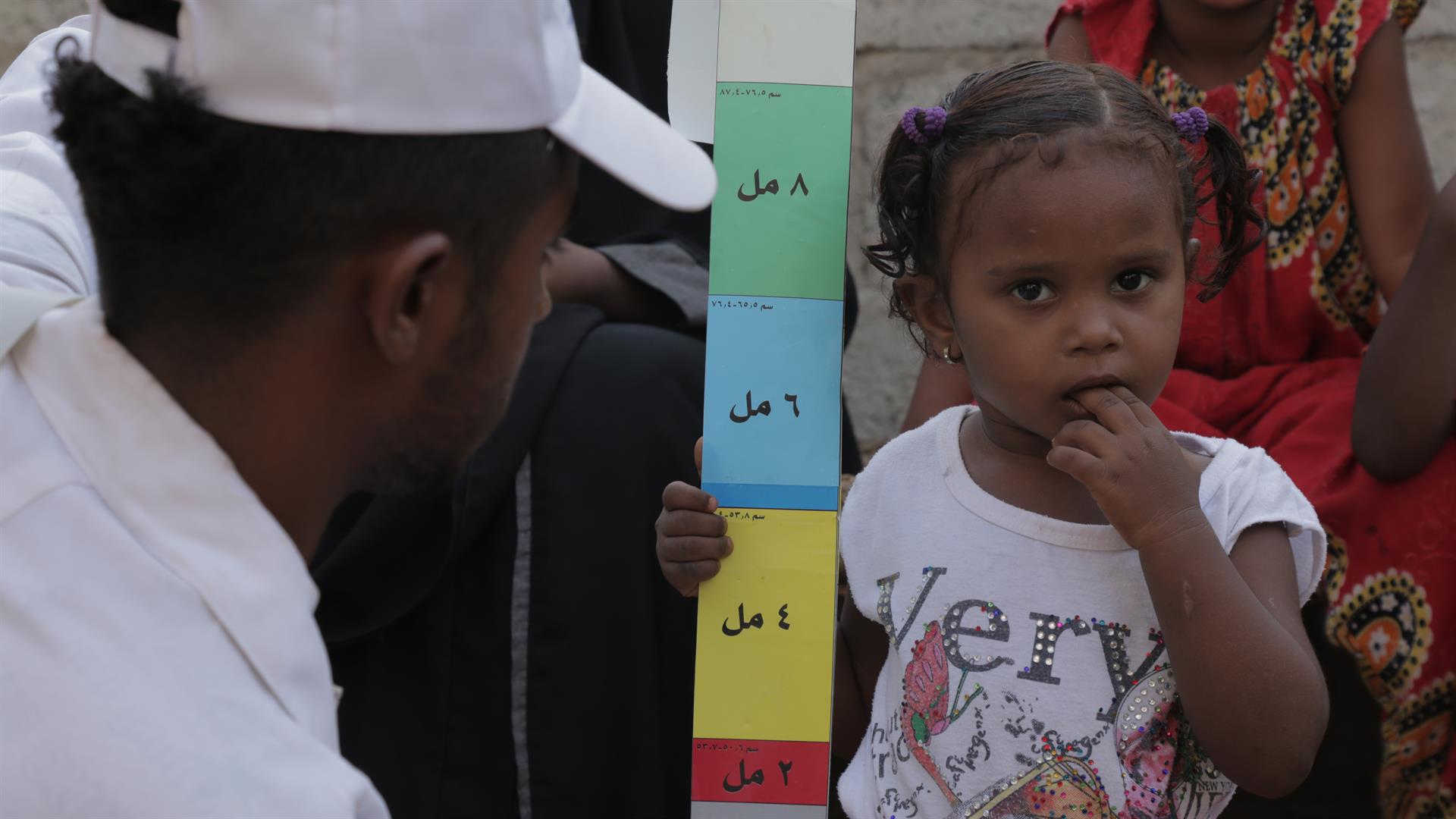
Trachoma treatment campaign in Yemen
Eliminating trachoma through high-quality data
National elimination of trachoma as a public health problem is defined as:
- less than 0.2% of ≥15-year-olds having unmanaged trachomatous trichiasis; AND
- less than 5% of 1-9-year-old children having the active (inflammatory) trachoma sign “TF”, in each formerly-endemic district; PLUS
- the existence of a system to detect and manage new cases of trachomatous trichiasis.
The first two of these criteria require reliable data on the proportion of people in a population that have trachoma, which in epidemiological terms is known as the prevalence of disease. Decisions on the need for interventions against trachoma also rely on good-quality district-level prevalence data. To help national programmes generate sound data, in consultation with the trachoma community, WHO has developed and published detailed guidance on undertaking surveys:
- Design parameters for population-based trachoma prevalence survey: strategic and technical advisory group for neglected tropical diseases, working group on monitoring and evaluation
- Design and validation of a trachomatous trichiasis-only survey: strategic and technical advisory group for neglected tropical diseases, working group on monitoring and evaluation
WHO has also created and fostered Tropical Data, a collaboration with the International Trachoma Initiative at the Task Force for Global Health; the London School of Hygiene & Tropical Medicine; RTI International; and Sightsavers, which supports national programmes to generate high-quality prevalence data by providing epidemiological, training, logistical and data management support for all types of cross-sectional surveys on trachoma. WHO provides oversight on survey protocols and ensures that country interests are maintained.