
Strengthening the partnership between WHO and France
Partner in global health
WHO is proud of its long and fruitful partnership with France. France shares key health priorities with WHO, adopting a cross cutting approach and prioritizing universal health coverage (UHC) as part of the 2030 Sustainable Development Agenda. France’s Global Health Strategy highlights the need to improve health systems strengthening and emergency preparedness, especially as they link to UHC. Achieving UHC requires building stronger health systems in countries and is tied to ambitious “triple billion” goals outlined in WHO’s 5-year budget.
As one of the 10 largest economies in the world, France is a major player in global health. It invests more than €500 million per year in multilateral funds such as the Global Fund to Fight AIDS, Tuberculosis and Malaria and Gavi, the Vaccine Alliance and is the largest contributor to Unitaid. Since it established its UHC social contract in 1945, the French health system continues to be one of the most innovative in the world. To help meet UN health goals France pioneered innovative financing mechanisms such as an airline-ticket levy and a tax on financial transactions among others.
France supports WHO's priority of making the world better prepared for health emergencies through the International Health Regulations (2005) and addressing the health impacts of climate change and the environment. To combat the growing illegal trade of tobacco products, often across borders, France became one of the 1st 48 signatories to the Protocol to Eliminate Illicit Trade in Tobacco Products. In 2019 WHO and France signed a Declaration of Intent to establish the WHO Academy to revolutionize lifelong learning in health. The Academy aims to reach millions of people with innovative learning via a state-of-the-art digital learning experience platform at a campus in Lyon and embedded in the six WHO regions.
Through the French Muskoka Fund, France and WHO are collaborating to reduce maternal, infant, child and adolescent mortality rates and improve access to quality sexual and reproductive health and nutrition services by strengthening health systems and capacity in West and Central Africa.
Strengthening the partnership between WHO and France
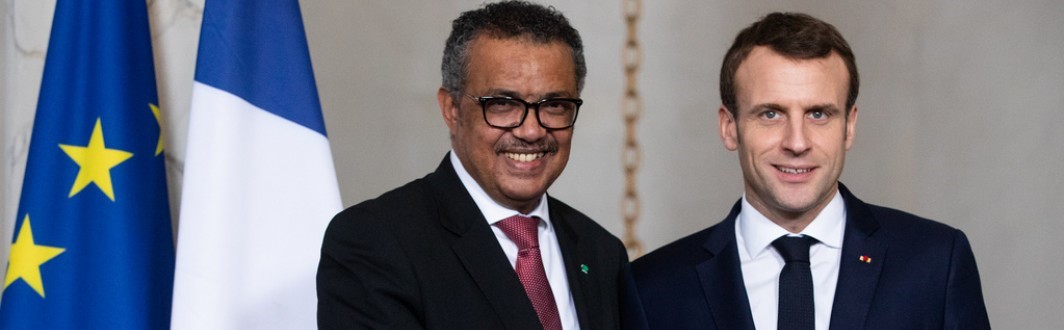
Le Président @EmmanuelMacron a rencontré le Directeur général de l’OMS.
— France ONU Genève (@FranceONUGeneve) January 11, 2019
Ensemble, ils ont donné une nouvelle impulsion à l’agenda de la santé mondiale. Ils ont décidé de faire émerger en France, et principalement à Lyon, un pôle de santé mondiale.
👉https://t.co/0gNfd73tPf pic.twitter.com/Tn39Wmaasc
Mother & child health is a big priority for #France & for @DrTedros as discussed in Paris w/ Ministers @JY_LeDrian and @agnesbuzyn #Muskoka https://t.co/EdfKe5PxnO
— Charles Tellier (@Charles_Tellier) August 27, 2017
Merci #France pour son leadership en santé mondiale. Nous nous réjouissons de renforcer notre partenariat#UHC #HealthForAll @WHO @DrTedros pic.twitter.com/jdKbTBMxrO
— Michèle Boccoz (@MBoccoz) July 12, 2018
Félicitations au président @EmmanuelMacron pour l'annonce de #MaSante2022 / WHO congratulates #France for the launch of “Ma Santé 2022” its new strategy for transforming 🇫🇷’s health system to focus on access, quality & people-centred care #HealthForAll https://t.co/TO0wBJhR1n
— Tedros Adhanom Ghebreyesus (@DrTedros) September 18, 2018
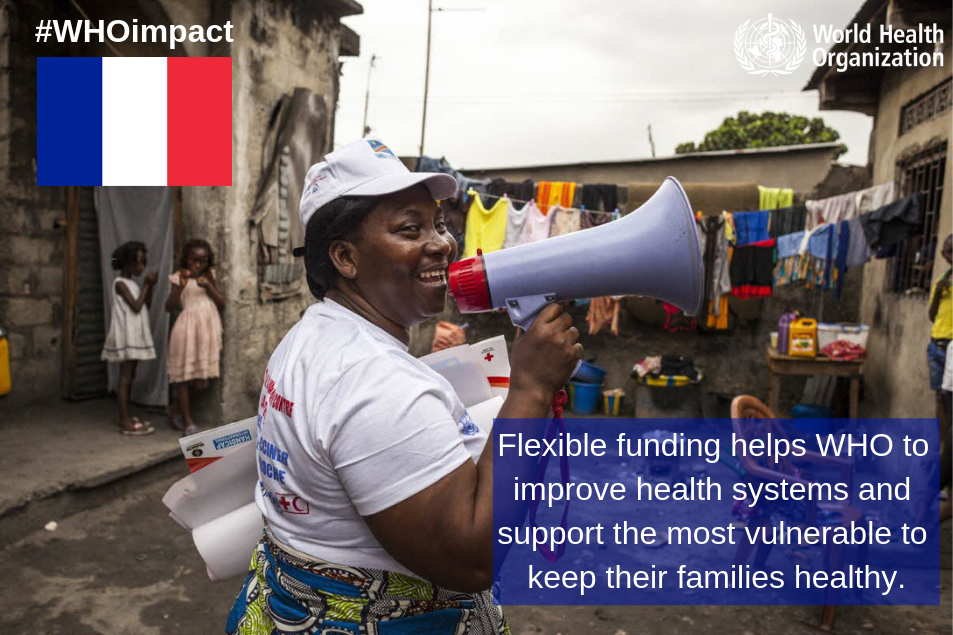
WHO is proud to partner with France, which contributed over US$ 74 million for the 2016-2017 biennium, almost a quarter of which was voluntary. France is a flexible donor, allocating US$ 0.68 million to WHO’s Core Voluntary Contribution Account. Flexible funding allows WHO to assign funds when and where they are needed by ensuring that less well-funded activities benefit from a better flow of resources.
For the 2016-2017 biennium French funds contributed to the following areas:
International health security, including the fight against epidemics and pandemics, is one of the priorities of the 2014-2019 framework agreement between France and WHO. Established in 2000, the WHO Lyon Office collaborates with country and regional offices to assist countries to strengthen their national surveillance and response systems to better detect, assess, notify events and respond to public health risks and emergencies of international concern under the International Health Regulations (2005) (IHR).
France has been a major contributor to the office activities and human resources since its opening, through voluntary contributions of €600 000 per year, secondments from French institutions and Junior Professional Officers (until 2016). In addition, France contributed €5 million to the WHO Lyon Office over the 2017-2018 period, supporting WHO’s efforts to assist Member States to prevent diseases outbreaks and other public health events.
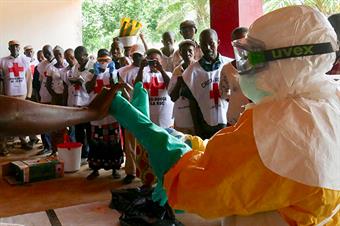
In 2018, the Lyon Office provided distance learning opportunities in technical areas to more than 4000 public health professionals though its Health Security Learning Platform. It also contributed to the global and regional preparedness efforts for all hazards, including for the Ebola Virus Disease, through numerous activities.
Rencontre avec le @DrTedros, directeur général de l’@WHO, sur les situations d’urgences sanitaires à #Lyon.
— Agnès Buzyn (@agnesbuzyn) December 4, 2018
✏️📜La signature de la déclaration d’intention avec l’#OMS est la traduction concrète de la détermination de la #France à apporter tout son soutien lors de ces situations pic.twitter.com/QgJU8YYq6z
WHO is grateful to France for providing political and financial support for WHO’s efforts in health, environment and climate change. In 2016, France and WHO, in close collaboration with the Government of Morocco, hosted the Second Global Conference on Health and Climate: Building Healthier Societies through implementation of the Paris Agreement. The Paris-based conference proposed key actions for the implementation of the Paris agreement to reduce health risks linked to climate change. France also supported the First WHO Global Conference on Air Pollution and Health, held 30 October – 1 November 2018, during which Dr Tedros declared, “Our dream is a world free of air pollution. To get there, we need to set an aspirational goal to reduce the number of deaths from air pollution by two-thirds by 2030.”
France has also provided funding to WHO/Europe for the European Environment and Health Process (EHP), which aims to eliminate the most significant environmental threats to human health. At the group’s Sixth Ministerial Conference in June 2017, representatives signed the Ostrava Declaration, providing tools to Member States to develop national portfolios for action and addressing the environment-related health goals and targets of the 2030 Agenda for Sustainable Development. France also contributed to WHO/Europe’s Transport, Health and Environment Pan-European Programme (THE PEP), which supports sustainable transport policies by promoting active mobility and public transport and helping to reduce air pollution, noise and greenhouse gas emissions.
WHO has a long history of partnering with French experts through France’s WHO collaborating centers. As of January 2019, France hosted 19 WHO collaborating centers, 7 of which are hosted by Institut Pasteur and its network. These centers contribute invaluable expertise to WHO on topics such as viral vaccines, bacterial infections, antibiotic resistance and mental health.
At the Institut Pasteur, the Department of Infection and Epidemiology hosts the WHO Collaborating Centre for Typing and Antibiotic Resistance of Salmonella, and the Department of Biology of Infection hosts WHO Collaborating Centre for Listeria. Both centres assist WHO in supporting its Member States to control and reduce the burden of foodborne diseases with their specific focus areas. Since the 1st designation in 1965, the Unité de Recherche et d'Expertise des Bactéries Pathogènes Entériques has continuously been assisting WHO in the areas of food safety and infection control, and recently extended its support on antimicrobial resistance. Biologie des Infections group also plays a significant role to support WHO in strengthening detection, control and prevention of listeriosis.
Since 1967, the WHO Collaborating Centre for the Family of International Classifications has been hosted by the Centre d’Epidémiologie sur les Causes médicales de Décès (CépiDC) in the Institut National de la Santé et de la Recherche Médicale (INSERM) and is also linked with the Agence technique de l'information sur l'hospitalisation (ATIH). The center plays an important role in maintaining, translating into French and implementing the International Statistical Classification of Diseases and Related Health Problems (ICD) and the WHO International Classification of Functioning, Disability and Health (ICF), as well in the development of computer assisted coding.
France’s participation in several universal health coverage (UHC) initiatives makes it a strong leader in the global movement to ensure access to all individuals and communities to quality services without financial hardship. In 2018, France co-hosted a high-level side event as a member of the International Health Partnership for UHC 2030: People’s voice and social participation: key roles and contributions to UHC at the 71st World Health Assembly. France is one of the founding members of the Social Health Protection Network (P4H), a global network dedicated to health financing, economics and social health protection for UHC through insight and knowledge brokerage, collaborative technical expertise and policy dialogue. France is championing investment in health workforce and played a lead role in co-chairing at presidential level the Health Employment and Economic Growth Commission in 2016. It supports implementation of the recommendations of the Commission through the French Muskoka Fund, especially in West African French speaking countries. France is a member of the Foreign Policy and Global Health Initiative which initiated in 2017 the UN resolution making 12 December the International UHC Day. Additionally, France has made UHC a guiding principle in its 2017-2021 Global Health Strategy.
Since 2016, France has been a contributor to the Partnership for UHC, which supports countries in strengthening their national health systems. France is also contributing to the WHO global work plan on UHC for the 2018-2019 period through support for the Foundation, Institution, Transformation (FIT) program, which offers technical guidance and operational support to Burkina Faso, Mauritania, Niger, Senegal and Mauritius. This initiative is expected to strengthen health systems in each country in an appropriate and context-specific way, leading to sustainable goals. WHO also welcomes the support received for co-financing technical expertise on health financing and UHC in headquarters and collaboration on heath workforce through the French Muskoka Fund.
Since 2011, France has invested €110 million in the French Muskoka Fund (FFM), with €31 million allocated to WHO. The Fund is a unique initiative based on collaboration between WHO, UNICEF, UNFPA and UN Women. Denmark also recently joined the FFM for a 3-year period. FFM seeks to reduce mortality rates among mothers, infants, children and adolescents through strengthening capacity and health systems in 8 countries from Western and Sub Saharan Africa. The Fund allows WHO to support member states to improve access to quality services including essential medicines and other health products, such as blood products for women and children, as a contribution to universal health coverage and to the attainment of the SDGs.
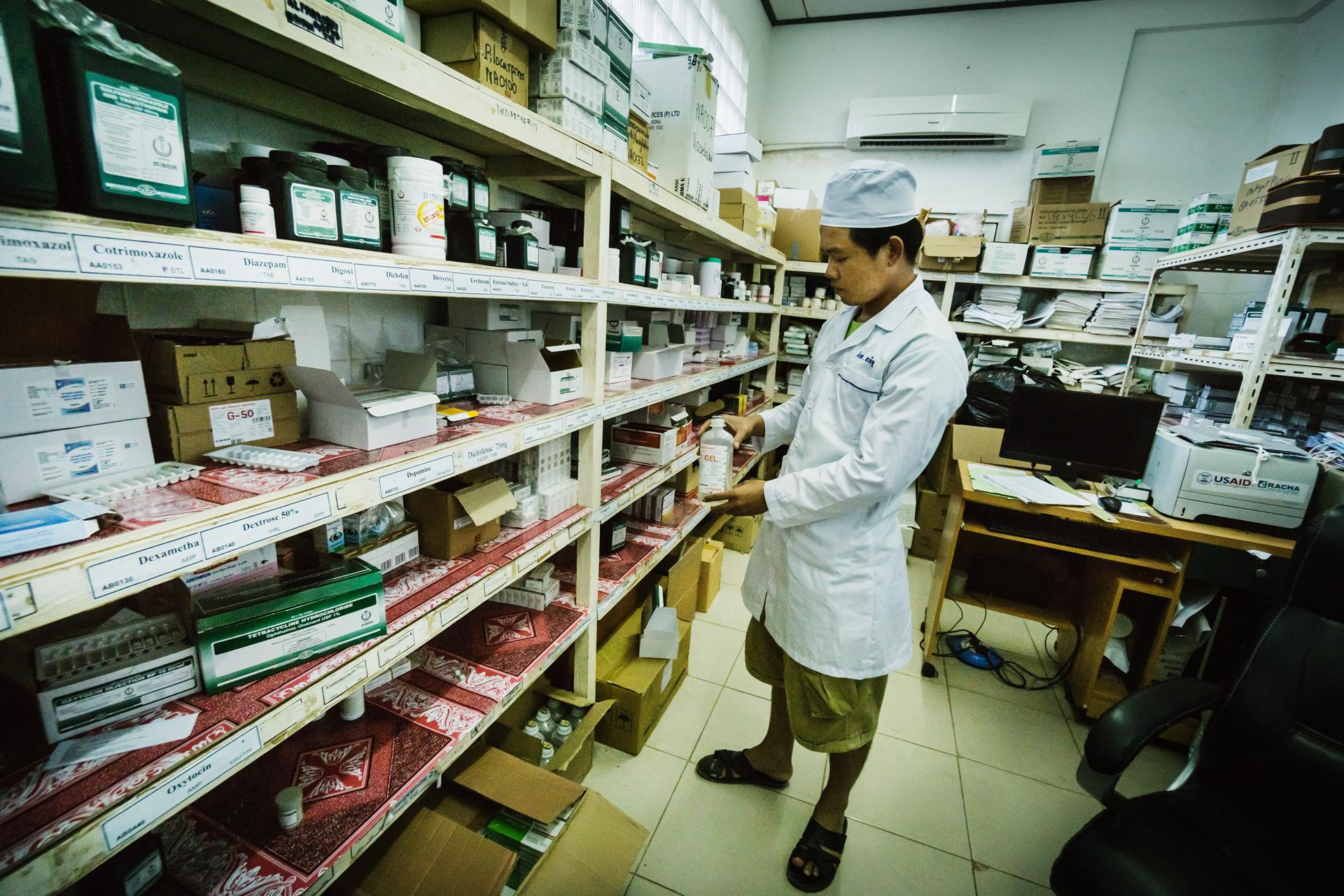
France has given crucial support to WHO’s work in African countries by making health products experts available to WHO. France’s expertise is instrumental for the development of robust WHO norms and standards to ensure quality, safety and efficacy of medicines and health products best practice - for their production, dispensing and use, including tackling the issue of substandard and falsified products.
WHO action has had greater impact also because of the close collaboration with French partners such as France Expertise (French Agency for International Cooperation), Initiative 5%, SWEDD initiative and other international partners and Non-State Actors like the African Association of Central Medical Stores (ACAME).
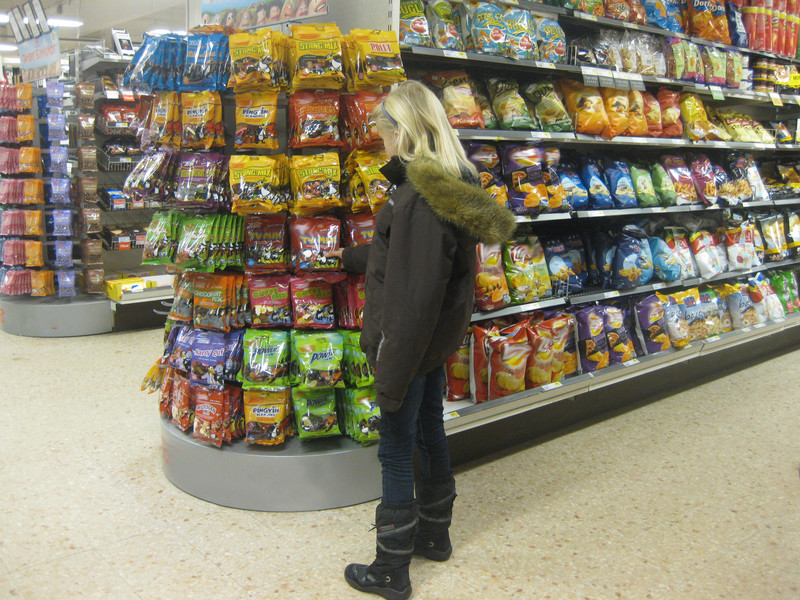
France is committed to improving consumer choices by making nutritional information accessible and easy to understand. In 2017, France contributed € 100 000 to WHO towards the establishment of an Action Network under the umbrella of the Decade of Action on Nutrition 2016-2025. The network will facilitate exchanges on nutrition labeling between member countries, advocacy and provision and sharing of expertise for the implementation of nutrition labeling.
As pioneers in nutrition labeling, France became the second country in the European region to implement a color-coded front-of-pack labelling (FOPL) scheme for nutritional information. Nutri-Score utilizes a nutrient profiling system which classifies foods and beverages into five categories of nutritional quality ranging from green (grade A) to red (grade E) and was associated with a better nutritional profile of supermarket purchases in a scientific study.
According to the European Food and Nutrition Action Plan 2015-2020, improved food labeling can help consumers to understand the nutritional content of their foods, especially complex processed foods, and may affect diets by encouraging food producers and retailers to reformulate their products.
Minister Le Drian announces France’s budget for foreign aid will be quadrupled in 2019. #France #SDGs #WHO pic.twitter.com/WjB5jXDy4Z
— Michèle Boccoz (@MBoccoz) August 29, 2018
« La #France & l’OMS (@WHO) partagent plusieurs valeurs communes.
— ONU Info (@ONUinfo) October 31, 2018
La + importante étant sans doute l’égalité.
Comme la 🇫🇷, nous sommes convaincus que la #santé est un droit humain, pas un privilège »@DrTedros devant la Commission @AN_AfEtr d’@AssembleeNat pic.twitter.com/CmV6grIasD
The @WHO conference on #airpollution and health opens today in Geneva
— France ONU Genève (@FranceONUGeneve) October 30, 2018
Air pollution😷causes 7 million deaths each year: that is 1 in 9 deaths worldwide 🌍
👉We need urgent action to protect the environment and the health of people#BreathLife #CleanAir4Health pic.twitter.com/egm6VsKL6e
Today I signed an agreement with France's Minister of Health @agnesbuzyn in which #France will provide care for people carrying out an assignment for WHO who are infected with a highly pathogenic disease in the performance of their duties.
— Tedros Adhanom Ghebreyesus (@DrTedros) December 4, 2018
Thank you 🇫🇷. I hope we never use it! pic.twitter.com/85XNTfuyWl